
AI in UAE Last-Mile Delivery: Hype vs Reality — What Actually Works in 2026
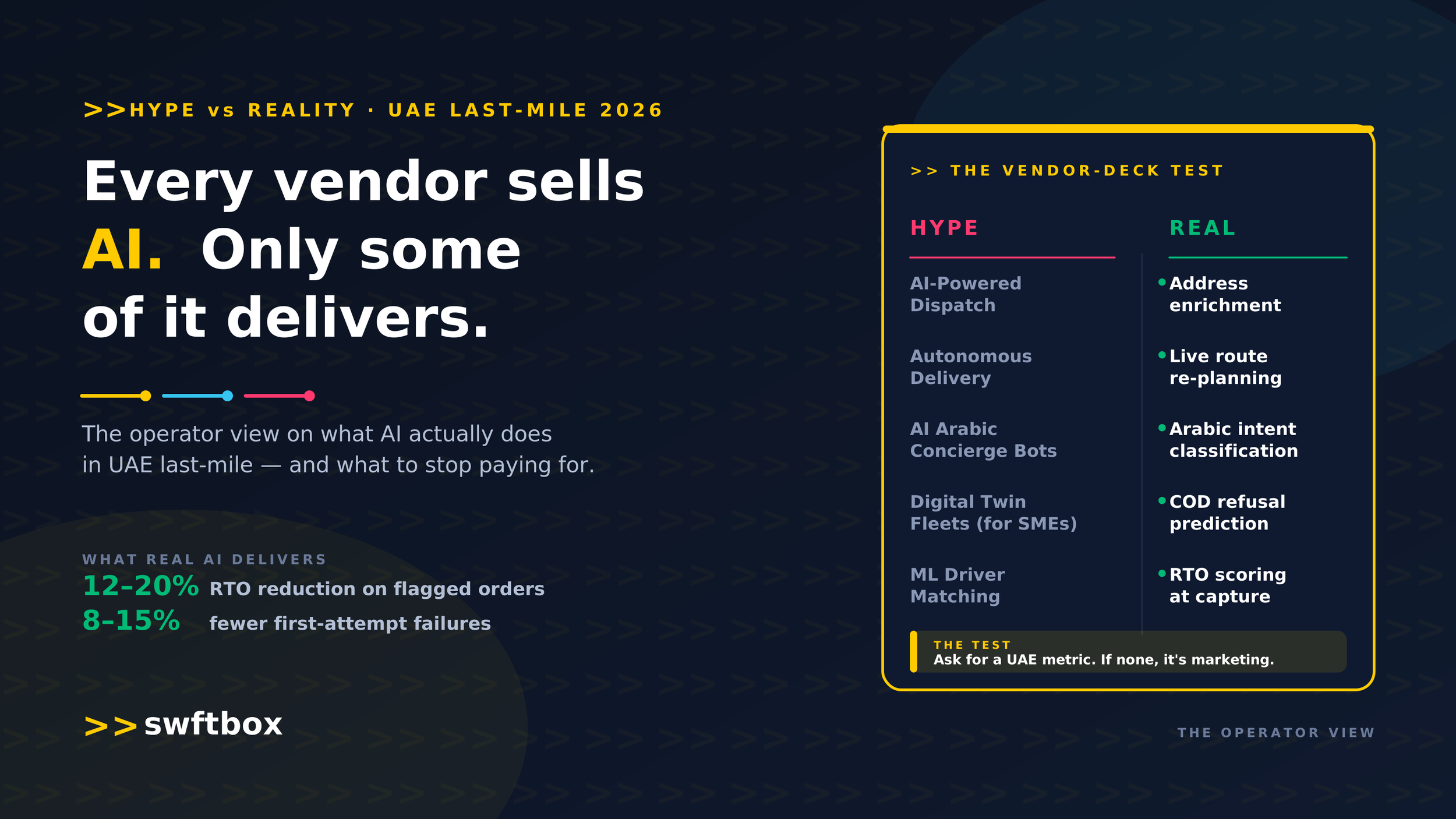
Every logistics vendor pitching to UAE ecommerce brands right now says "AI-powered." Most of it is packaging. A smaller share is real — and it's not the parts you see in the deck.
This piece separates the two, from the operator side. If you're a UAE merchant evaluating a 3PL, a delivery app, or an ops platform in 2026, this is the read-before-you-sign version.
The same POV that drives our take on what LinkedIn gets wrong about UAE ecommerce applies here. Not every buzzword deserves a budget line.
What does "AI in last-mile" actually mean in UAE ecommerce?
AI in last-mile is a catch-all for four things: address handling, routing, communications, and prediction. Vendors bundle them under a single "AI-powered" badge, but the technologies underneath are different, and only some of them are working at scale in the UAE right now.
Here's how to read a vendor's AI claim before you take it at face value.
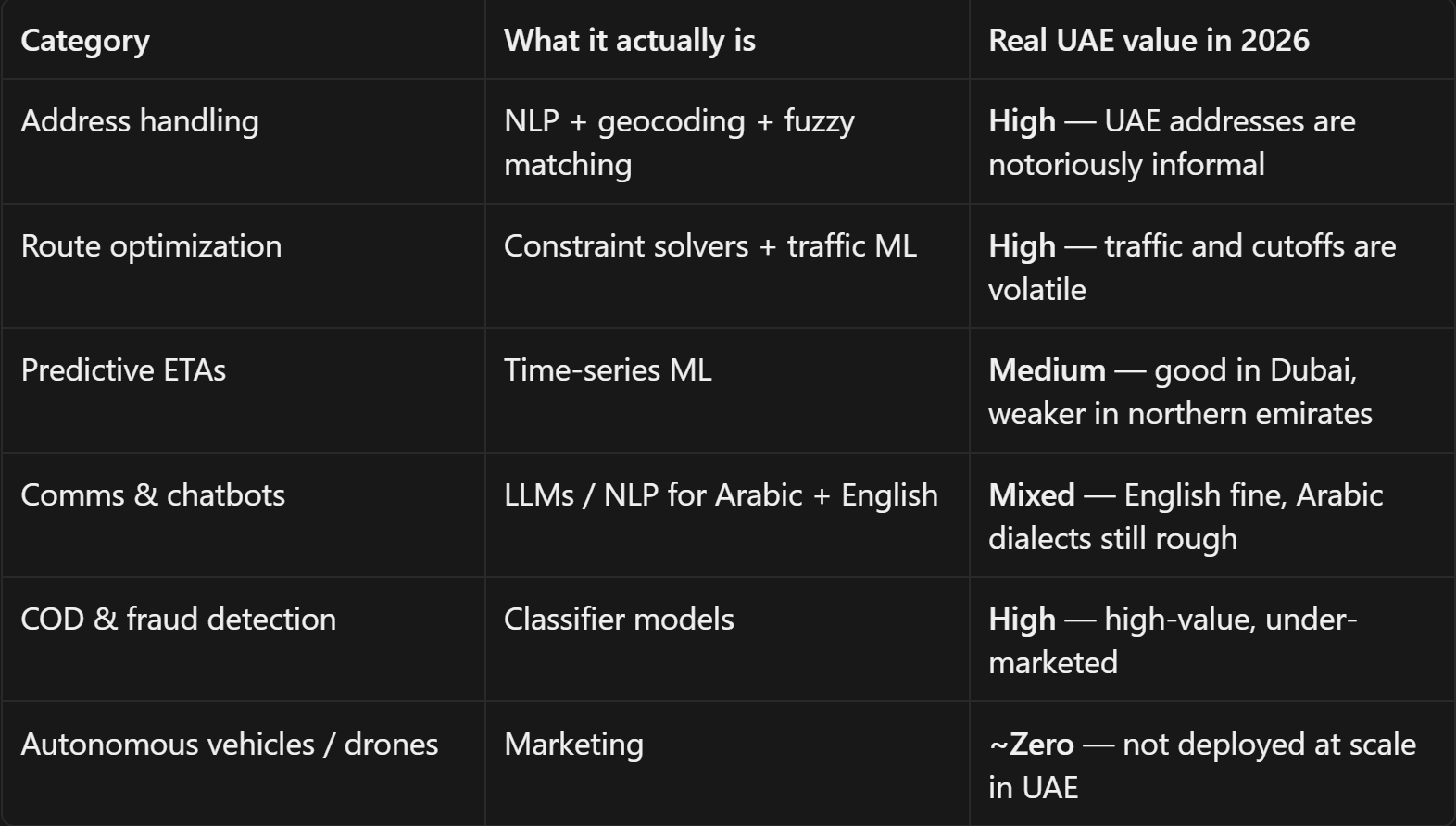
Everything below drills into which of these earn their keep and which don't.
What does AI genuinely do well in UAE last-mile?
Four things. Two of them move the needle for merchants. Two are quietly critical for operators.
1. Cleaning bad UAE addresses
The single most valuable AI application in UAE last-mile is address enrichment. Merchants routinely receive shipping addresses that look like "villa near the mosque behind ADNOC in Al Barsha" — descriptive, human-readable, unroutable.
Modern address models take that string, cross-reference Makani numbers, Google Places, WhatsApp shared locations, and postal databases, and return a rider-usable coordinate. Done well, this reduces first-attempt failures by 8–15% on the merchants we work with. That's real margin, not a keynote statistic. We break down the underlying problem in our bad addresses piece.
2. Route optimization when the constraints are real
Route optimization has been called "AI" since 1959. The 2026 version is genuinely better than the 2016 version — because it can now ingest live traffic, driver capacity, dynamic cutoffs, and COD constraints simultaneously and re-plan mid-shift.
A specific UAE example: a mid-morning Sheikh Zayed Road incident used to cascade into 40+ missed same-day windows across Dubai Marina and JLT because dispatch couldn't re-plan fast enough. Modern optimizers reroute the affected drops to nearby drivers within minutes, shifting the same-day promise from broken to still-honored.
For UAE brands doing >500 daily parcels across mixed emirates, this is real cost reduction. For brands doing 50, a spreadsheet still works.
3. Arabic NLP for WhatsApp order comms
WhatsApp is the operational backbone of UAE ecommerce whether merchants admit it or not — we covered this in the WhatsApp orders piece. AI genuinely helps with:
Auto-classifying inbound Arabic WhatsApp messages by intent (delivery question, address change, reschedule).
Extracting shipping details from voice notes.
Detecting cancellation signals before the driver arrives.
A concrete example: a customer voice-notes "المندوب لسا ما وصل، خلاص لا تجيبوا اليوم" ("the courier hasn't arrived, don't send it today"). A dialect-aware model catches the cancellation intent immediately and holds the drop. A weak model waits for a human to listen to the voice note hours later — by then the driver has already attempted, failed, and started an RTO. The best implementations in-region are dialect-aware. The worst use general Modern Standard Arabic and misroute everything.
4. Predictive COD & RTO scoring
The quietest high-value AI in UAE ecommerce is fraud and RTO prediction. Models score each order at capture time based on address quality, phone risk signals, order pattern, and category. UAE brands with a proper implementation cut RTO by 12–20% on flagged orders — usually by shifting them to prepaid nudges before dispatch.
The specific signals matter. A UAE COD refusal model that actually works uses: repeat-customer history, order value bracket, delivery emirate, weekday-vs-weekend, address-completeness score, phone-number reputation (VoIP vs SIM), category-level base rates (fashion RTO ≠ electronics RTO), and time-since-order. A model trained on any three of those is noise; a model trained on all of them, on UAE-specific volume, is a P&L line.
You will not see this in vendor marketing decks. You will see it in P&L improvements at brands that have it.
What are UAE logistics vendors overselling as "AI"?
Six patterns show up repeatedly. If a vendor demo leans on any of these, ask harder questions.
"AI-powered dispatch"
Sometimes this is real ML. Often it is a rules engine with a machine-learning label. The tell: ask what happens when a rule changes (e.g., a new Saudi cutoff time). If the answer involves the vendor's engineering team editing config, it's rules, not AI.
"AI concierge" chatbots replacing human CS
English chatbots are decent. Arabic chatbots in 2026 still fail on dialect, code-switching (Arabizi), and cultural nuance. A UAE customer typing "wein el driver 3ashan ana 3end el mall" (mixed Arabic-English written in Latin characters — pure Arabizi) breaks most models. So does an Egyptian expat asking a delivery question in Egyptian Arabic while your bot was trained on Gulf Arabic. Every UAE brand we see that replaced human CS with an "AI concierge" has quietly walked half of it back — usually within 60 days, once the CSAT numbers come in.
"Machine learning matching" for driver-order assignment
Basic driver assignment — zone + capacity + priority — is a rules problem. Adding ML to it doesn't beat well-designed rules until you're at massive scale. Most UAE operators aren't there yet.
"Autonomous delivery"
Drones and autonomous vehicles in UAE ecommerce last-mile in 2026 are pilots and PR, not deployed volume. Real Emirates last-mile is a hot climate, dense buildings, guarded compounds, informal addresses, and elevators. Consider a routine Dubai Marina delivery: guard-controlled entry, RFID-gated parking, elevator access to floor 34, then a customer who wants the parcel handed over — not left at reception. No drone or autonomous vehicle in 2026 completes that handoff without a human. Autonomy is nowhere close to solving that in production, and pilot photos from Expo City don't change the operational reality.
"Digital twin fleet management"
Interesting technology. Marginal ROI for UAE fleets under a few hundred vehicles. If a vendor pitches this to a merchant with <10k monthly parcels, that's a red flag.
"AI Arabic voice assistant"
Only take this seriously if you can test it with your own audio in your own customers' dialects. Emirati, Egyptian, Levantine, and Sub-continental Arabic accents all sound different, and vendors demo the ones their models handle.
Why does UAE last-mile challenge AI harder than global markets?
Four structural reasons the standard "AI works everywhere" pitch breaks down here.
Address data is fragmented: SPL Short Addresses in KSA, Makani codes in Dubai, informal descriptions everywhere else. Models trained on US or European address data get lost immediately.
Arabic is not one language: Emirati Arabic, Gulf Arabic, Levantine, and Egyptian dialects all appear in UAE customer bases, alongside Arabizi (Arabic in Latin script with numbers). Training data for these is thin compared to English.
COD makes prediction messier: A meaningful chunk of UAE orders are paid on delivery, which introduces refusal risk that non-COD-heavy models don't handle well. This is a data problem, not just a modeling problem.
Dataset scale is small: UAE ecommerce parcel volume is a rounding error compared to the US or China. Models trained on regional data have less to learn from; models trained on global data don't fit the region well. Neither is fully solved yet.
None of this makes AI useless in UAE last-mile. It means the good implementations are the ones built by teams who actually ran the region's operations. The bad ones are global tools rebadged with a UAE flag.
How should a UAE merchant evaluate an AI claim from a vendor?
Five questions. Ask all five. Watch how the room reacts.
What specific problem does this AI solve, and what was the metric before and after? If the answer is a category ("efficiency," "customer experience") not a metric (RTO %, first-attempt %, minutes per stop), it's marketing.
Was the model trained on UAE data? Not MENA data. Not global data with "some Gulf coverage." UAE-specific data, ideally with the merchant's category included.
What happens when the model is wrong? Real systems have a graceful failure path. Marketing systems don't have an answer.
Can I test it with my own edge cases? Bad addresses, Arabic messages, cancellations, peak Ramadan traffic patterns. If the answer is "we'll show you our demo," walk.
What's the pricing when the AI adds no value? If you pay the same whether the model helps or not, the vendor is not aligned with your outcome.
What's actually coming next in UAE last-mile AI?
Three realistic developments in the next 12–18 months, and three that keep getting promised without delivery.
Realistic, will likely arrive:
Better Arabic dialect handling for comms and voice notes, driven by regional LLM improvements.
Address enrichment that combines SPL Short Address, Makani, WhatsApp shared location, and delivery history into a single confidence score.
COD refusal prediction moving from post-dispatch to pre-checkout, giving merchants a chance to convert to prepaid before the parcel moves.
Promised, probably won't:
Fully autonomous UAE last-mile at commercial scale.
Drone delivery beyond pilot / VIP use cases.
"One-model-for-everything" AI ops platforms that replace human dispatchers.
If a vendor's 2027 roadmap leans hard on the second list, they're selling the pitch, not the product.
What's the operator takeaway?
AI is real in UAE last-mile. It's just narrower than the marketing suggests. The wins are in address cleaning, route optimization at scale, Arabic comms, and predictive scoring on COD and RTO. Everything else is either mature technology relabeled, pilot-stage experimentation, or straight-up story.
For a UAE merchant in 2026, the question isn't "does this vendor have AI?" — of course they say they do. The question is "does this vendor's AI solve my specific problem with UAE-specific data and a measurable outcome?"
Ask that question. Most vendors won't have a good answer. The ones who do are the ones worth working with.
Want the operator view on your own delivery ops? Book a 20-minute UAE last-mile review with Swftbox
What are the most common questions about AI in UAE last-mile delivery?
What does AI actually do in UAE last-mile delivery?
The four applications with real value are: address cleaning, route optimization, Arabic comms processing (WhatsApp intent classification), and predictive scoring on COD refusal and RTO risk.
Are drones being used for UAE ecommerce delivery in 2026?
No — not at commercial scale. UAE last-mile in 2026 remains overwhelmingly human-driver operated. Drone deliveries exist as pilots and PR, not deployed volume.
Can AI reduce RTO rates in UAE ecommerce?
Yes, meaningfully. UAE brands using predictive RTO scoring at order-capture typically reduce RTO on flagged orders by 12–20%, mostly by converting risky COD orders to prepaid before dispatch.
Do UAE addresses need AI to be delivered correctly?
Not always, but they benefit from it. UAE addresses are frequently informal ("villa near the mosque behind the mall"). AI-based address enrichment combined with WhatsApp shared location and Makani codes can reduce first-attempt failures by 8–15%.
Is Arabic NLP good enough for UAE customer service in 2026?
Partially. English chatbots are functional. Arabic chatbots still struggle with dialect variation, Arabizi, and cultural nuance. Best used for classification and routing, not as a full CS replacement.
What's the biggest sign a vendor's "AI" is marketing rather than real technology?
If they can't answer "what specific metric improved by what percentage on UAE data?" — it's marketing. Real AI implementations have measurable outcomes on your specific data, not category-level generalities.
Is Swftbox using AI in its own operations?
Yes — for address enrichment and route optimization all trained on UAE-specific data. We don't claim AI for anything we can't attach a metric to.
