
UAE Ecommerce Customer Retention Starts After the First Order: Here's Why Delivery Is the Fix
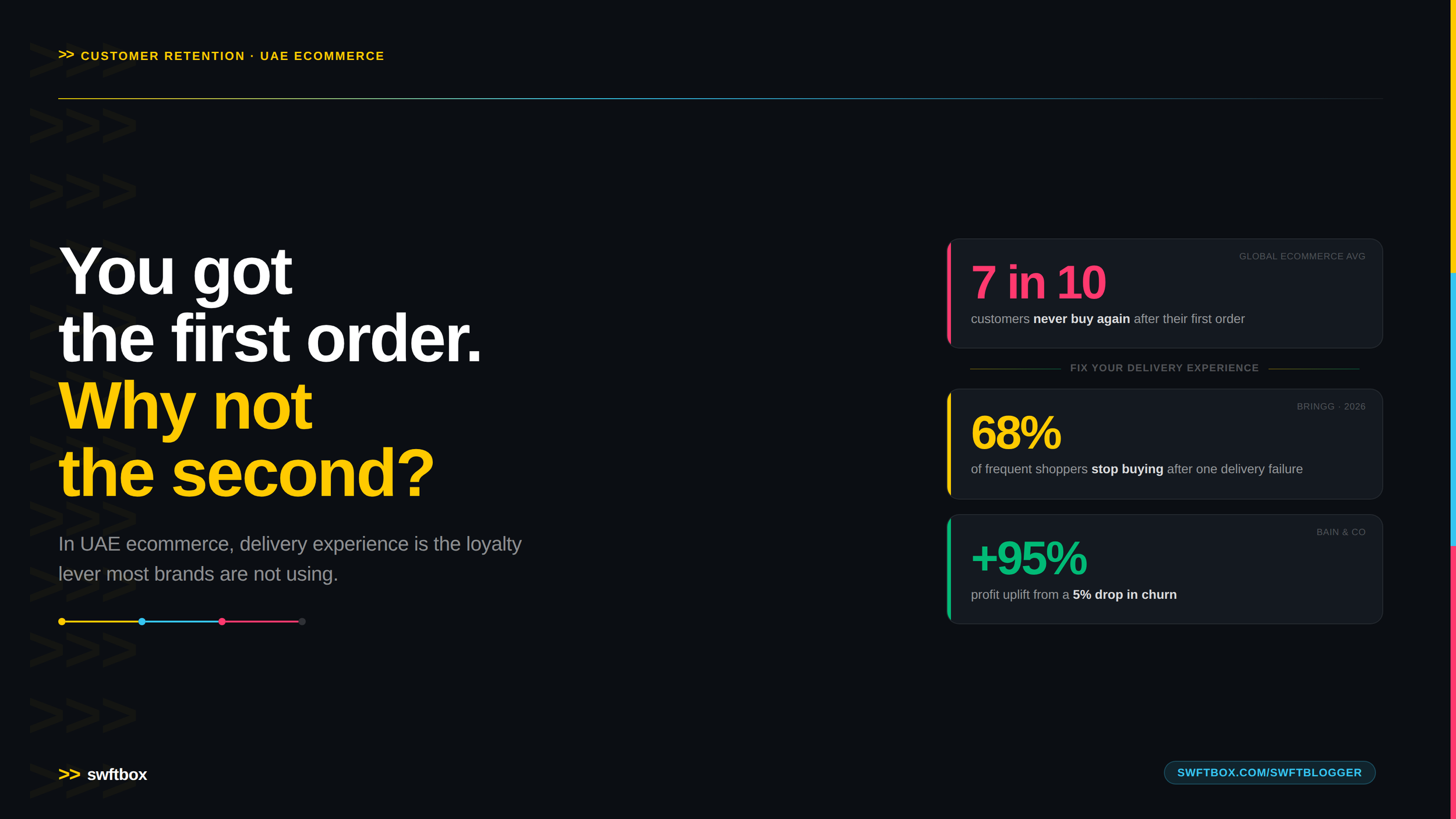
Most UAE ecommerce brands obsess over getting the first order. Very few obsess over the second.
UAE ecommerce customer retention is the number that determines whether a brand grows sustainably or burns through acquisition budgets indefinitely. Yet most brands spend almost nothing on it.
Think about where your last marketing budget went. Paid social. Influencer campaigns. Google ads. Discount codes for first-time buyers. All of it pointed at one moment: the buy button.
And when the order came in, you celebrated. Rightly so.
But here is the question worth sitting with: of the customers who bought from you in the last 90 days, how many came back?
If your honest answer is fewer than three in ten, you are not facing a marketing problem. You are facing a post-purchase problem. And the part of the post-purchase experience that drives more of it than anything else is delivery.
What Is the Real Cost of Poor UAE Ecommerce Customer Retention?
UAE ecommerce customer retention has a measurable cost — and most brands are underestimating it. Across global ecommerce, the average repeat purchase rate sits between 25 and 30 percent. That means roughly 7 out of every 10 customers who buy from you once will never buy again. Not because your product was wrong. Not because your price was high. Because the experience after the buy button did not earn a return visit.
The financial weight of this is significant. Acquiring a new customer costs five to seven times more than retaining an existing one. Repeat customers spend more per order, cost less to reach, and are more likely to refer others. And the compounding effect is real: a customer's second purchase makes a third 45 percent more likely; a third makes a fourth 54 percent more likely (Sender, 2026).
In UAE ecommerce, where customer acquisition costs are rising alongside competition, repeat purchase rate is one of the highest-leverage numbers a brand can move. Most are not tracking it closely enough.
Why Do UAE Customers Blame the Brand, Not the Courier, When Delivery Fails?
Customer retention in UAE ecommerce depends on a shift most brands have not caught up with yet. Here is something that has changed quietly over the last few years.
In 2022, when something went wrong with a delivery — a late parcel, a missed attempt, no updates — most shoppers blamed the shipping carrier. By 2025, that had changed. Only 39 percent of shoppers now point to the carrier. The majority hold the merchant responsible (nShift, 2026).
This matters because it means your delivery partner's performance is now your brand's reputation. A delay your courier caused is a delay your customer associates with you. A missed delivery attempt your logistics provider failed to rebook is a broken promise your brand made.
Two thirds of online shoppers report feeling anxiety after clicking buy, driven primarily by uncertainty around delivery timing, tracking, and what happens if something goes wrong (Narvar, 2025). That anxiety starts the moment the confirmation email lands. How you manage it — or fail to — determines whether that customer feels confident enough to return.
Which Delivery Failures Most Damage UAE Ecommerce Customer Retention?
The delivery moments that destroy customer retention in UAE ecommerce are rarely dramatic. Most failures are not dramatic. There is no lost parcel or damaged box. The loyalty break happens in quieter, more forgettable ways. Three patterns show up most consistently.
The silent failure: The order ships. No meaningful update follows. The customer checks their email, finds nothing except a generic confirmation. They search for a tracking link, land on a carrier page, and try to decode a status that says "in transit" without any context. By the time the parcel arrives, the anxiety has already done its damage. They got what they ordered — but the experience left a residue of doubt.
Brands that send proactive, branded shipping updates reduce WISMO (where is my order) support tickets by 50 to 80 percent. More importantly, they replace the anxiety window with a touchpoint that reinforces trust (LateShipment.com, 2026).
The attempt friction: A delivery is attempted while the customer is unavailable. No easy rescheduling option is offered. The parcel sits at a depot. The customer has to find a number, make a call, navigate an automated system, and arrange a second attempt — all for something they already paid for.
The data on what happens next is clear: 68 percent of high-frequency shoppers have stopped buying from a brand entirely after a single delivery failure. Among regular shoppers, that number is 42 percent (Bringg, 2026). A single missed attempt, handled poorly, can end the relationship permanently.
The returns block: The product does not work out. The customer looks for the return process and finds a PDF policy, an email address, and a five to seven business day wait for a response. Somewhere in that friction, they decide it is not worth the effort. They keep the product. They do not come back.
Ecommerce returns average 20 to 30 percent of all orders. How a brand handles that moment directly determines whether the customer buys again. A frictionless return process — self-serve, fast, and outcome-certain — retains 20 to 30 percent of revenue that would otherwise disappear (Claimlane, 2026).
If you want to understand the economics of turning returns into a loyalty lever rather than a cost, the swftbox guide to ecommerce returns as a profit centre covers the full framework.
How Can UAE Ecommerce Brands Use Delivery to Improve Customer Retention?
Improving UAE ecommerce customer retention through delivery comes down to three decisions. The brands that earn the second order are not necessarily the fastest. They are the most reliable and the most communicative.
Three delivery decisions have the highest impact on repeat purchase rate.
First-attempt success rate as a KPI: Most UAE ecommerce brands measure delivery speed. Fewer measure how often a delivery succeeds on the first attempt. A failed first attempt costs an average of 17.78 percent more per order when reattempt, support, and customer dissatisfaction are included (Veho, 2025). Making first-attempt success a tracked metric — and choosing a delivery partner who optimises for it — is one of the most direct levers available.
Proactive, branded tracking communication: The period between dispatch and delivery is not dead time. It is a brand moment. Customers visit tracking pages an average of three to five times per order. If that page is a carrier's generic interface, that is three to five missed opportunities to reinforce brand identity and reduce anxiety. If it is a branded page with proactive updates, it becomes a loyalty touchpoint.
The difference between a customer who feels looked after and one who feels forgotten is often a single well-timed message that says: your order is on its way, here is exactly when to expect it.
For a practical breakdown of how real-time order tracking shapes the post-purchase experience, the swftbox guide to keeping customers in the loop outlines the key elements.
A returns process customers do not dread: According to Salesforce (2025), 90 percent of consumers agree the post-purchase experience is as important as the product itself. Returns are the most emotionally loaded part of that experience. A customer who finds the return process easy and fast is far more likely to buy again — even if the original product did not work out.
The connection between checkout transparency and post-purchase trust also runs in the other direction. Customers who understood delivery options clearly at checkout report higher satisfaction with the delivery experience, even when something goes wrong. The UAE Ecommerce Checkout Report 2026 documents the specific gaps most UAE Shopify stores still have at the checkout stage — gaps that compound into post-purchase loyalty problems downstream.
Why Is Customer Retention the Most Underused Advantage in UAE Ecommerce?
UAE ecommerce customer retention is the highest-return investment most brands are not making. UAE ecommerce is more competitive than it has ever been. Acquisition costs are rising. Product differentiation is harder to sustain. Price competition is relentless.
In that environment, retention is not a secondary concern. It is the primary one.
A 5 percent reduction in customer churn can increase profitability by 25 to 95 percent (Bain & Company). That range is wide, but even the lower bound represents a return no acquisition channel can match.
The brands that will grow sustainably in the UAE over the next two years are not the ones who find cheaper acquisition. They are the ones who build a post-purchase experience strong enough that a customer's first order is never their last.
Delivery is not the whole answer. But it is the part of the post-purchase experience that UAE ecommerce brands most consistently underinvest in — and the part that customers most consistently remember.
The Second Order Is the Real Test
The first order is a transaction. The second order is a verdict. It means the customer weighed everything — the product, the price, the experience of receiving it — and decided your brand was worth returning to. That verdict is not made at checkout. It is made in the hours and days after the parcel leaves your warehouse: whether it arrived when you said it would, whether they knew where it was, whether returning it felt easy or impossible. Every one of those moments is a delivery decision. And every one of them is within your control
