
The UAE Ecommerce Checkout Report 2026: What Shopify Stores Get Right (and Wrong) About Delivery
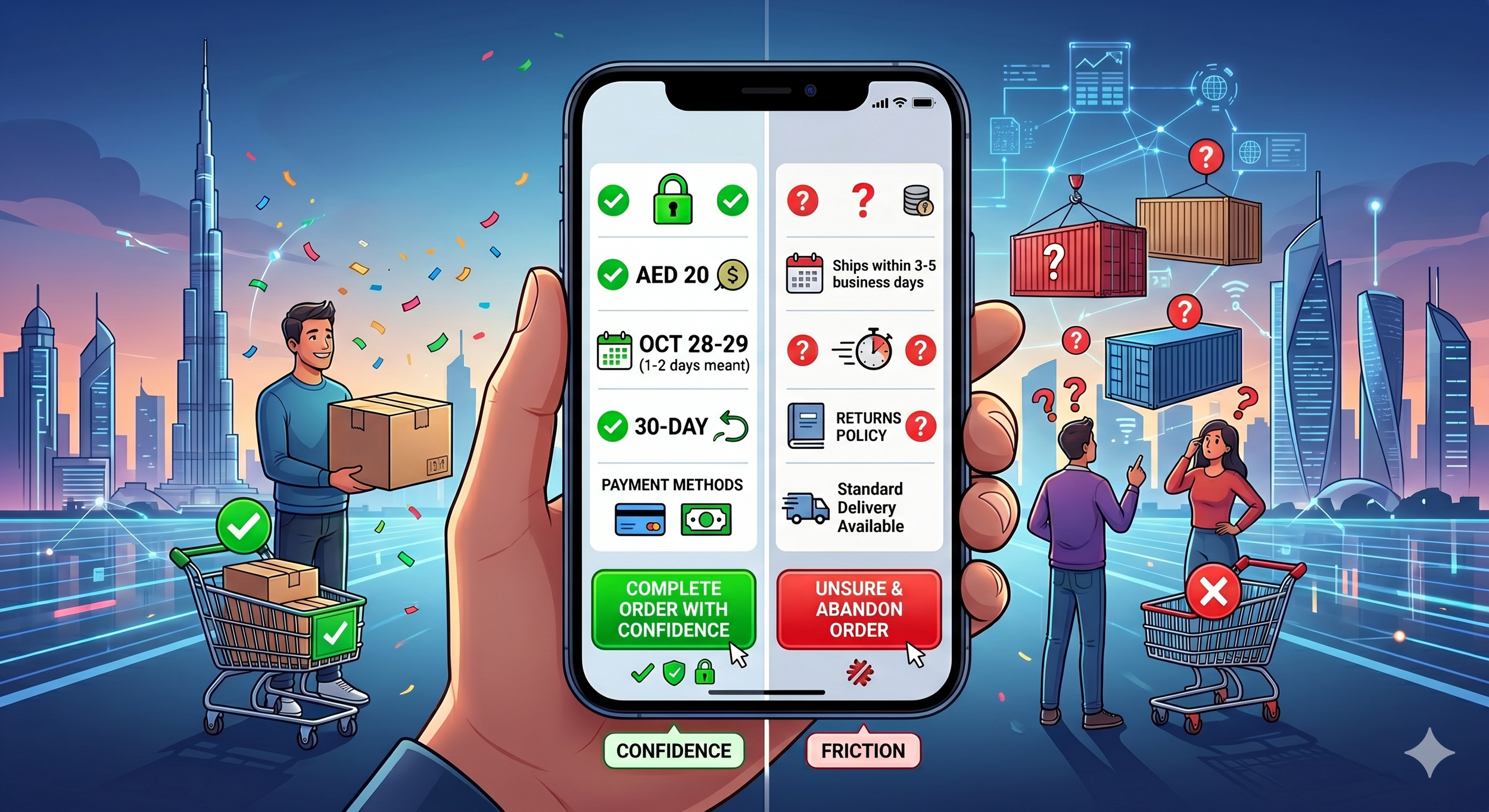
For most ecommerce brands, the checkout page is where conversion happens—or where it disappears.
Brands invest heavily in advertising, website design, product photography, and customer acquisition. Yet many overlook one of the most important parts of the customer journey: the delivery experience presented at checkout.
To better understand how delivery is communicated in UAE ecommerce, we reviewed a selection of Shopify-powered stores across fashion, beauty, home goods, electronics, and food & beverage categories. Rather than focusing on products or pricing, we looked specifically at how merchants communicate shipping costs, delivery speeds, cash-on-delivery options, and return policies.
The goal was simple: identify the checkout experiences that build customer confidence—and the ones that create unnecessary friction.
The findings reveal a clear trend. Most UAE ecommerce brands are offering delivery. Far fewer are communicating it effectively.
Why Delivery Information Matters More Than Ever
Modern ecommerce customers are not only buying products. They are buying certainty.
Before placing an order, shoppers want answers to a few simple questions:
How much will delivery cost?
When will my order arrive?
Can I pay with cash on delivery?
What happens if I need to return the product?
When these answers are easy to find, trust increases.
When they are hidden until the final stages of checkout, customers become hesitant.
As ecommerce competition continues to increase across the UAE and GCC, delivery communication is becoming a conversion factor rather than a purely operational consideration.
What We Reviewed
For this analysis, we examined publicly available delivery information across a diverse group of UAE Shopify stores.
The review focused on:
Shipping cost visibility
Delivery speed options
Cash-on-delivery presentation
Delivery promise clarity
Return policy accessibility
Rather than ranking brands, the objective was to identify patterns that ecommerce operators can learn from.
Several positive examples emerged, particularly among brands that make delivery expectations visible before checkout begins.
Finding #1: Shipping Costs Are Often Communicated Too Late
One of the most common patterns we observed was that shipping costs were not visible until customers reached the checkout process.
From an operational perspective, this may seem harmless.
From a customer perspective, it creates uncertainty.
The strongest checkout experiences communicate delivery costs early, either on the product page, cart page, or within a dedicated delivery section.
Brands such as The Giving Movement stand out by clearly displaying delivery options and associated costs before customers reach checkout. This removes guesswork and allows shoppers to make informed decisions earlier in the buying journey.
The lesson is simple:
Customers do not dislike delivery fees as much as they dislike surprises.
Finding #2: Many Stores Offer Delivery Options but Do Not Explain Them
The UAE has one of the most advanced delivery ecosystems in the region.
Same-day delivery, next-day delivery, scheduled delivery, and standard shipping are increasingly available.
Yet many stores present delivery options without context.
Customers are often left wondering:
What is the difference between express and standard delivery?
What is the cutoff time for same-day delivery?
Which emirates qualify for faster service?
The best-performing experiences answer these questions proactively.
For example, stores that clearly communicate delivery timelines and cutoff times help customers understand exactly what they are paying for.
Clarity reduces hesitation.
Finding #3: Cash-on-Delivery Remains Important
Despite the continued growth of digital payments, cash-on-delivery remains a significant expectation for many ecommerce shoppers across the UAE and GCC.
However, the visibility of COD varies considerably.
Some brands present it clearly alongside other payment methods. Others only reveal it during checkout or within FAQ sections.
The strongest implementations treat COD as a customer convenience rather than an operational detail.
When customers can easily see available payment methods, they are more likely to complete the purchase with confidence.
Finding #4: Delivery Promises Are Often Too Generic
Many ecommerce stores still rely on vague delivery language such as:
"Ships within 3–5 business days"
"Delivery available across UAE"
"Orders processed quickly"
While technically accurate, these messages do little to help customers understand when they will actually receive their order.
The most effective stores communicate delivery expectations with precision.
Clear delivery windows, location-specific timelines, and cutoff times help transform delivery from an uncertainty into a competitive advantage.
Customers value predictability.
Finding #5: Return Policies Are Frequently Treated as Legal Pages
A return policy is one of the strongest trust signals in ecommerce.
Yet many stores treat returns as compliance content rather than conversion content.
In several cases, return information was available only through footer links or policy pages.
The strongest examples made return information visible near products or checkout decisions.
This simple change reassures customers before they commit to a purchase.
For higher-consideration products, return visibility can have a direct impact on conversion rates.
What the Best Checkout Experiences Have in Common
Across categories, the strongest checkout experiences shared several characteristics.
They were not necessarily the fastest.
They were not necessarily the largest brands.
But they consistently communicated delivery information clearly.
The most effective stores:
Display delivery costs before checkout
Explain delivery speeds clearly
Show COD availability early
Make return policies easy to find
Set realistic delivery expectations
In other words, they remove uncertainty.
The Bigger Trend: Delivery Is Becoming Part of Conversion Optimization
Historically, delivery was viewed as an operational function that happened after the sale.
That mindset is changing.
Today, delivery is increasingly part of the buying experience itself.
Customers evaluate delivery options before making purchasing decisions.
They compare speed, convenience, payment flexibility, and transparency.
As a result, checkout optimization is no longer limited to design and payment gateways.
Delivery experience has become a critical part of ecommerce conversion strategy.
What UAE Ecommerce Brands Can Learn
The takeaway from this review is not that UAE ecommerce has a delivery problem.
In fact, many merchants offer excellent delivery services.
The opportunity lies in communication.
The brands creating the strongest customer experiences are not simply offering delivery.
They are making delivery easy to understand.
For ecommerce operators, this means asking a few important questions:
Can customers see delivery costs before checkout?
Are delivery options clearly explained?
Is COD visible?
Are return policies easy to access?
Are delivery expectations realistic and specific?
Small improvements in these areas can significantly improve customer confidence.
Conclusion
The UAE ecommerce ecosystem continues to evolve rapidly.
Customers have become comfortable with fast delivery, multiple payment options, and flexible fulfillment models.
What they increasingly expect is transparency.
Our review found that the most effective checkout experiences are not necessarily those with the fastest delivery promises.
They are the ones that provide the clearest expectations.
Because in ecommerce, customers do not buy certainty after checkout.
They buy it before they click "Place Order."
