
Customs Clearance in MENA: What Actually Delays Cross-Border Packages from the UAE in 2026
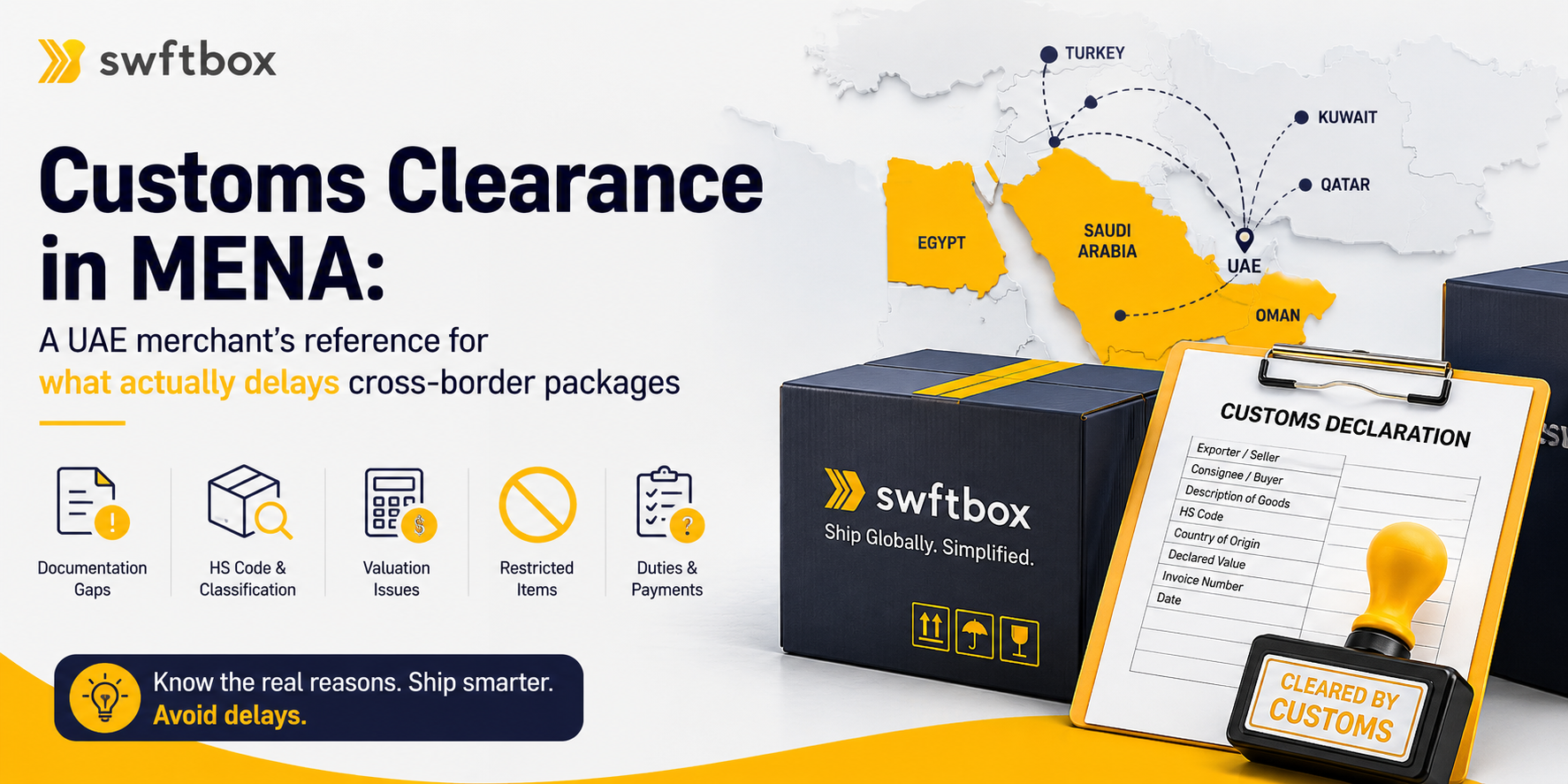
Most ecommerce merchants think customs clearance delays happen because customs is slow.
In reality, most avoidable delays are created before the shipment ever reaches the border. The package arrives carrying incomplete product information, an inconsistent declared value, a missing phone number, or a compliance gap.
Customs becomes the point where those problems surface — not the source of them.
This reframe matters, because it changes the question merchants should be asking. The question isn't "how do customs systems move faster?" It's "how do merchants stop creating shipments customs needs to investigate?"
Why Does Customs Clearance Matter for UAE Ecommerce Brands in 2026?
For UAE ecommerce brands expanding into GCC and wider MENA markets, customs clearance is the single most underestimated source of delivery friction.
Industry research consistently shows that cross-border ecommerce shipments take longer than merchants forecast — with clearance delays of 3 to 7 days being common across MENA corridors when documentation is incomplete. According to DHL's MENA cross-border ecommerce research, customs and last-mile complexity are the two largest predictors of delivery failure on the route.
For a UAE merchant scaling to KSA, Kuwait, or Egypt, that delay translates directly into refund requests, support tickets, and lost repeat purchases.
The brands that grow internationally without losing customer trust treat customs clearance as part of their customer experience strategy — not as a downstream logistics function. This is a meaningful shift from how most merchants think about cross-border shipping, and it is the central operational lesson of cross-border ecommerce in 2026.
Why Does Customs Clearance Matter for UAE Ecommerce Brands in 2026?
For UAE ecommerce brands expanding into GCC and wider MENA markets, customs clearance is the single most underestimated source of delivery friction.
Industry research consistently shows that cross-border ecommerce shipments take longer than merchants forecast — with clearance delays of 3 to 7 days being common across MENA corridors when documentation is incomplete. According to DHL's MENA cross-border ecommerce research, customs and last-mile complexity are the two largest predictors of delivery failure on the route.
For a UAE merchant scaling to KSA, Kuwait, or Egypt, that delay translates directly into refund requests, support tickets, and lost repeat purchases.
The brands that grow internationally without losing customer trust treat customs clearance as part of their customer experience strategy — not as a downstream logistics function. This is a meaningful shift from how most merchants think about cross-border shipping, and it is the central operational lesson of cross-border ecommerce in 2026.
What Actually Delays UAE-Origin Shipments Across MENA?
The friction point depends on the destination. Each MENA market produces a different type of customs delay, driven by a different underlying weakness in how merchants prepare their shipments.
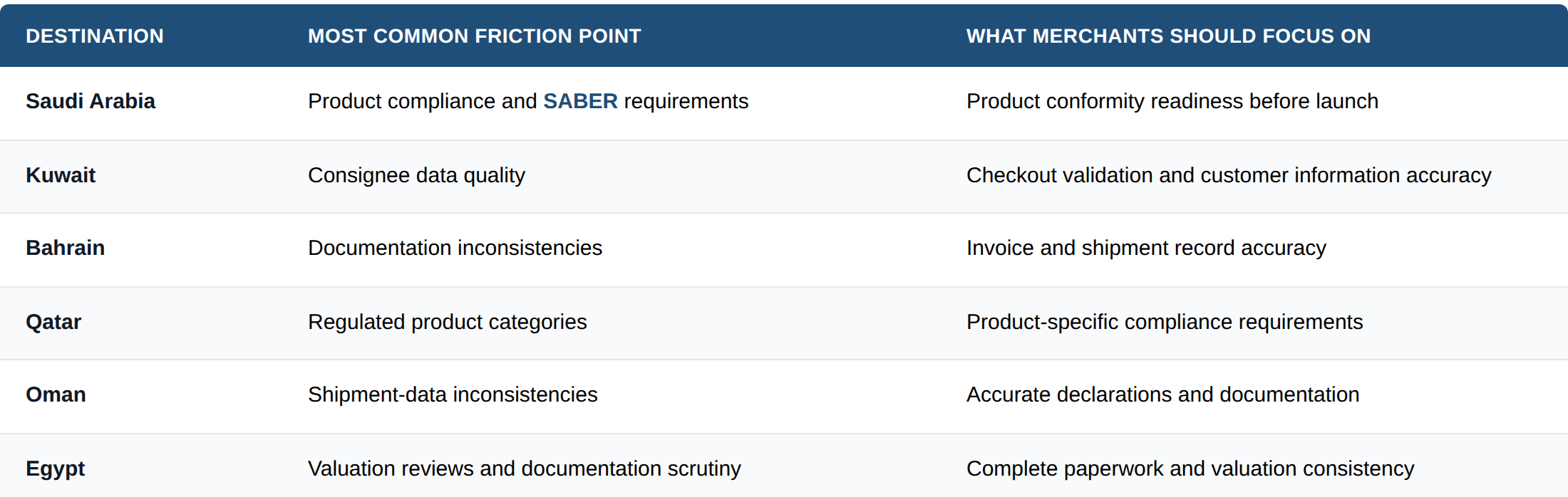
This table is the operational summary. The sections below explain why each market behaves differently — and what UAE merchants can do about it.
Why Do Saudi Arabia Shipments Get Delayed?
Saudi Arabia is the largest ecommerce market in the GCC and the destination where UAE merchants most often underestimate compliance requirements.
The most important Saudi-specific factor is SABER — Saudi Arabia's product conformity assessment platform. Depending on the product category, shipments may require conformity documentation before entering the market. Categories commonly affected include electronics, cosmetics, toys, and a range of consumer goods.
Many first-time exporters focus on shipping logistics and overlook conformity requirements until customs requests supporting documentation. When this happens, clearance delays of several days are common — and recovery requires producing documentation that should have existed before the shipment was created.
The key lesson is structural: many Saudi customs issues are not customs issues at all. They are product-compliance issues, and they are best solved before the first order is shipped, not after the first delay.
For UAE merchants, that means treating product conformity as a precondition for KSA expansion, not a downstream concern. Brands that prepare SABER documentation before launch consistently see smoother clearance than brands that prepare it reactively after their first held shipment.
Why Do Egypt Shipments Get Delayed?
Egypt should not be treated as simply another MENA destination.
Egypt's customs environment differs significantly from GCC corridors. Where GCC customs delays are usually operational and resolve quickly with complete documentation, Egypt applies a deeper level of scrutiny — particularly on declared values and supporting paperwork.
A declared value accepted elsewhere may receive additional review in Egypt, especially when:
Product values appear inconsistent with category norms
Product descriptions are overly generic
Documentation does not clearly support the declared value
Higher-value consumer goods are involved
This does not necessarily mean the shipment is undervalued. It means customs may require additional confidence that the declared value reflects the real transaction.
The key lesson is that for Egypt, documentation quality becomes a competitive advantage. Egypt merchants that maintain consistent invoices, product descriptions, and declared values typically experience meaningfully fewer disruptions than merchants with the same products and the same shipping speeds but weaker paperwork.
This makes documentation discipline — not shipping speed — the primary lever for Egypt success.
Why Do Kuwait, Bahrain, Qatar, and Oman Shipments Get Delayed?
Each remaining GCC corridor produces its own dominant friction pattern. Understanding the difference between them is the difference between treating MENA as one market and operating it as the six distinct customs environments it actually is.
Kuwait delays often start at the merchant's checkout, not the border. Missing phone numbers, missing country codes, and incomplete consignee details produce more avoidable Kuwait delays than any other single cause. Strong checkout validation typically reduces Kuwait friction more than changing carriers does.
Bahrain is one of the more efficient GCC destinations operationally — which becomes its own risk. Merchants assume documentation matters less because clearance is generally fast. When documentation issues do occur, they typically come from overconfidence rather than complexity. Bahrain rewards disciplined documentation practices that merchants might skip elsewhere.
Qatar customs reviews often focus on regulated product categories — wireless electronics, telecommunications equipment, certain health products, and other controlled goods. For Qatar, understanding whether a product category requires additional approvals matters more than optimizing shipping speed.
Oman customs delays are rarely caused by complex regulations. They are caused by inconsistencies — between invoice values and declared values, between product descriptions and HS codes, between shipment data and what customs systems expect. For Oman, accuracy matters more than sophistication.
What Are the Most Common Cross-Border Customs Mistakes to Avoid?
Across MENA corridors, most preventable customs clearance delays come from a small number of recurring issues. The five mistakes below account for the majority of avoidable holds across every UAE-origin corridor.
Vague product descriptions. Declarations like "accessories" or "electronics" trigger additional review. "USB-C charging cable" or "men's cotton polo shirt" don't. Specificity in product descriptions is one of the highest-leverage controls any merchant has over their clearance performance.
Incorrect HS codes. Wrong classifications create duty discrepancies, manual review, and clearance delays — especially for products requiring regulatory approvals. Product-specific HS classification matters more than broad category coding.
Valuation inconsistencies. When declared values appear inconsistent with category norms or invoice data, customs may request verification before release. This is the single biggest delay driver for Egypt and a meaningful factor in KSA and Oman.
Restricted product categories. Cosmetics, supplements, medical products, food items, and certain electronics may require additional approvals depending on the destination market. Many merchants only discover these requirements after their first shipment is held.
Customer data errors. Missing phone numbers, missing country codes, and incomplete addresses cause more delays than many merchants realize — particularly in Kuwait, where consignee data quality is often the single biggest delay driver.
Returns operations face the same data-quality dependencies — see why returns are quietly becoming the biggest source of repeat-customer loss for how this connects to the broader customer experience.
How Should UAE Merchants Think About Customs Clearance in 2026?
For UAE merchants expanding across MENA, every destination teaches a different lesson:
Saudi Arabia = compliance problem (SABER readiness)
Kuwait = customer-data problem (checkout validation)
Bahrain = documentation discipline problem
Qatar = regulated-products problem
Oman = consistency problem
Egypt = valuation and documentation scrutiny problem
The brands that scale smoothly across the region are not the ones with the fastest shipping services. They are the ones that adapt their data, documentation, and compliance practices to the actual character of each market — instead of assuming what worked for one corridor will work for the next.
This is the operational discipline that separates cross-border ecommerce winners from the brands that try the region and pull back.
The Bottom Line
The biggest misconception about customs clearance is that delays are unpredictable.
Most aren't.
Most avoidable customs clearance delays originate from issues merchants can control: product data quality, documentation completeness, compliance preparation, and customer information accuracy. Customs is simply where those weaknesses become visible.
For UAE merchants expanding across GCC and wider MENA in 2026, customs clearance readiness is no longer a logistics function. It is a customer experience strategy.
Because the shipment that clears customs fastest is usually the one that never gave customs a reason to stop it in the first place.
For more on building cross-border operations that scale, see the strategic case for international delivery from the UAE.
