They don't show up as a single bad quarter. They don't trigger an alert. They compound quietly across three months of what looks like healthy growth — and then a founder pulls the unit economics apart one afternoon and realizes every single order to their new market is losing money.
This is that story.
Why do UAE brands underestimate cross-border delivery costs?
A UAE-based beauty brand had spent two years building a strong domestic business. Roughly 500–800 orders per month across UAE. Average order value around AED 220. Gross margin around 55%. Steady growth, disciplined ad spend, decent repeat rate.
By late 2025, the domestic market was starting to feel finite. Customer acquisition costs were rising. The same 4–5 competitors kept showing up in every paid auction. The founder ran the math and concluded — correctly — that international expansion was the next growth lever.
Saudi Arabia was the obvious first market. Larger population, higher AOV in the beauty category, cultural affinity, an established shipping corridor. The decision to expand made sense. The decision about how to price the delivery didn't.
What made free shipping the wrong default for KSA?
The founder benchmarked competitors and noticed something: most UAE beauty brands selling into KSA offered free shipping as a headline feature. Some had thresholds. Some offered it unconditionally. The message was consistent — free shipping was table stakes for winning KSA customers.
So the brand launched to KSA with unconditional free shipping.
The reasoning felt sound. The math the founder had run said the delivery cost per KSA order would be roughly AED 45–55. That was absorbable inside a 55% gross margin at a AED 220 AOV. The competitive lift from "free shipping" should outweigh the margin compression.
For the first six weeks, the numbers looked healthy. KSA orders started coming in. Volume grew. The launch felt like a success. Then the returns started arriving.
Which cross-border delivery costs get missed most often?
The delivery cost estimate — AED 45–55 per KSA order — was accurate for a successful delivery. It didn't account for what happens when a delivery isn't successful.
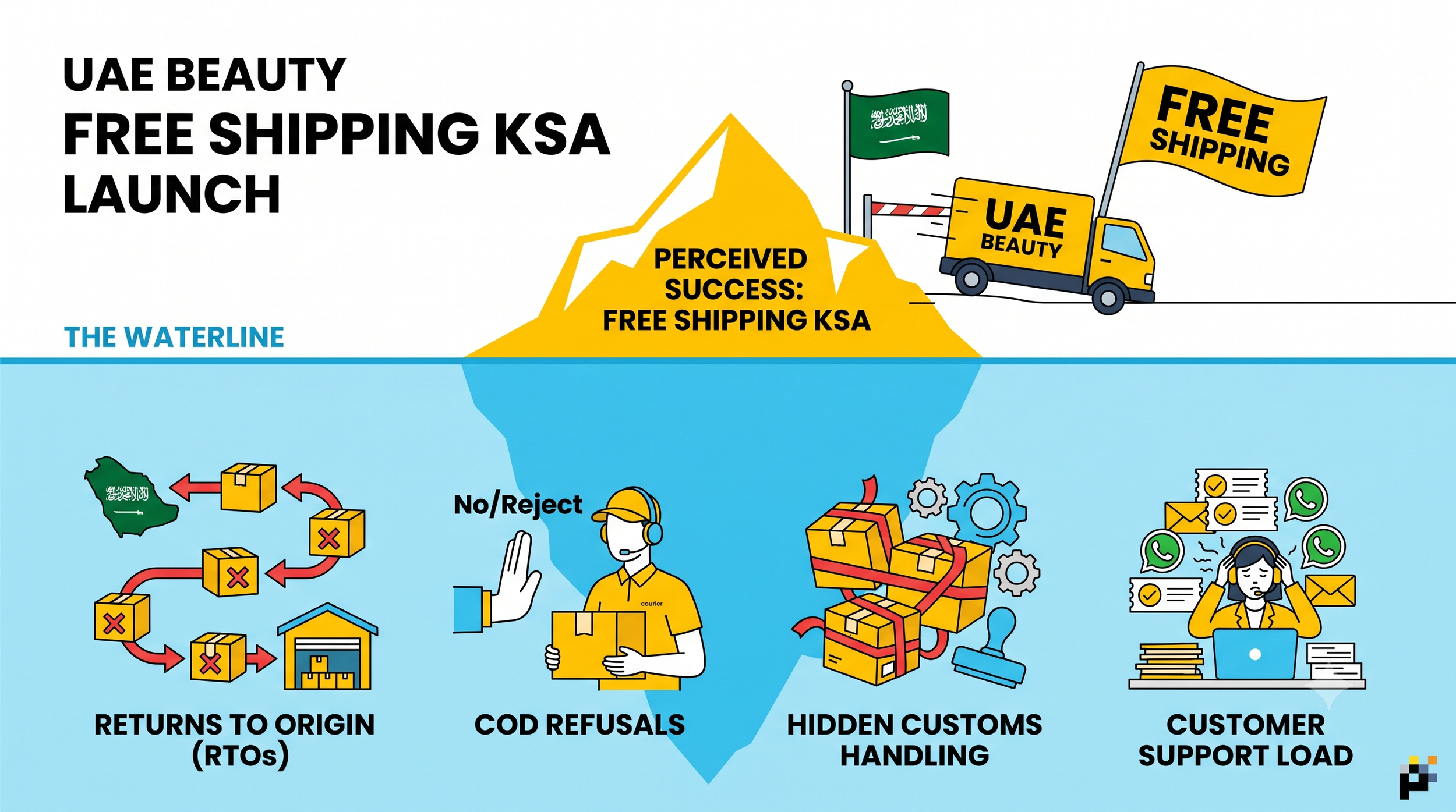
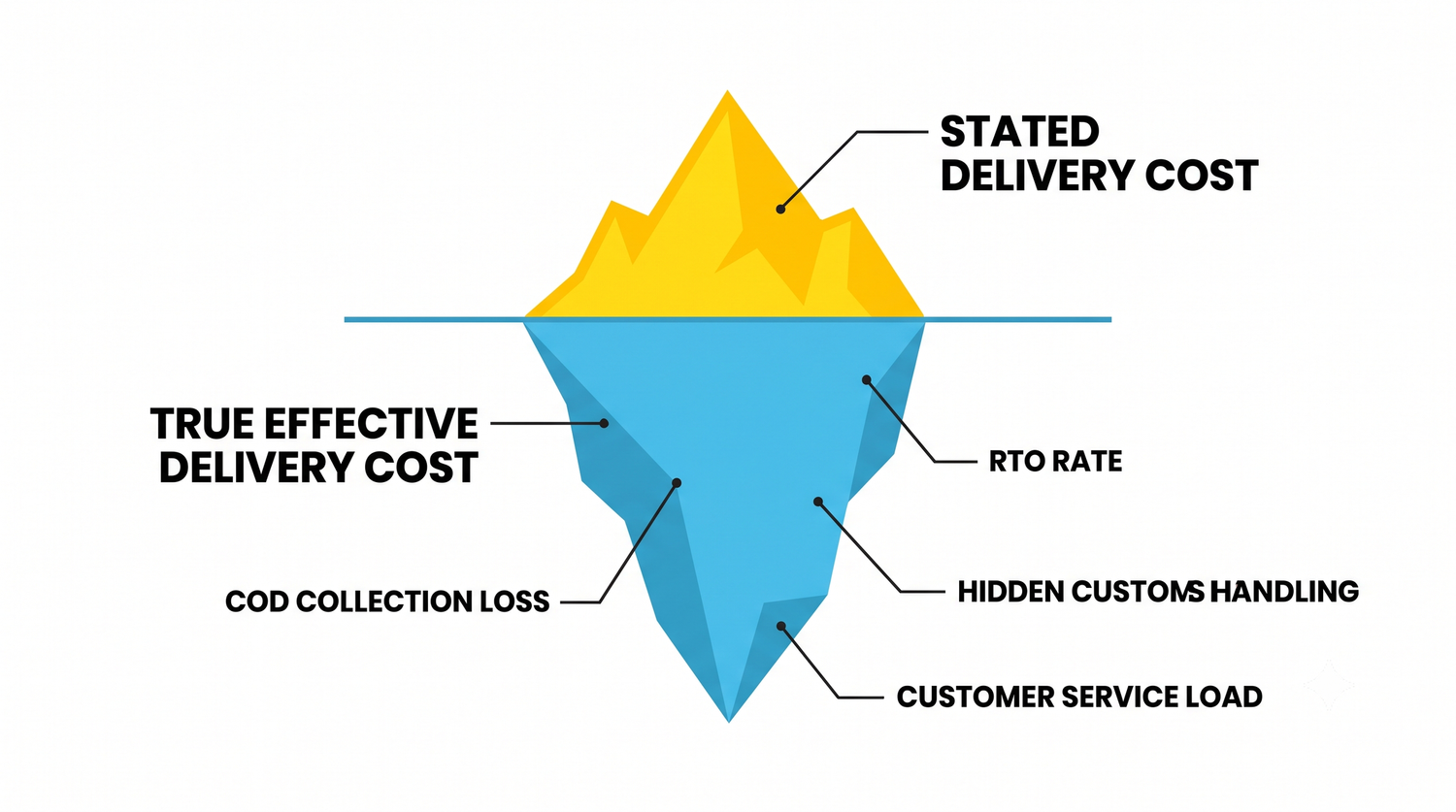
Four costs were missing from the model.
Cost 1: The RTO rate. Not every KSA order arrives. Some percentage of them — for this brand, around 18% in the first quarter — get returned to origin. Reasons varied: customer refused the COD parcel, wrong address, phone number unreachable, customs held longer than expected and the customer moved on. Every RTO shipment cost roughly the same as an outbound shipment. So for every 100 orders shipped, the brand was paying delivery cost on 118 shipments.
Cost 2: The COD collection loss. Around 40% of KSA orders were COD. Of those, roughly 12% had the payment refused at the doorstep — customer changed their mind, wasn't home, or didn't want to pay. The product had already shipped. The delivery had already been paid for. And now the cash wasn't coming in either.
Cost 3: Hidden customs handling. The brand had assumed customs was included in the carrier quote. It was — for the standard fee. What wasn't included was the additional handling when a shipment got flagged for SABER conformity review, which happened to a meaningful percentage of their skincare SKUs. Each flagged shipment added AED 15–25 in handling and 2–4 days in transit time.
Cost 4: Customer service load. Every delayed KSA order generated an average of 2.3 support tickets. The brand was answering WhatsApp messages in Arabic, coordinating with the courier, sometimes issuing partial refunds to save the customer relationship. None of this cost appeared in the delivery line item — but it was real, and growing linearly with KSA order volume.
What does true cross-border delivery cost actually look like?
By month four, the founder pulled the numbers together properly.
The stated delivery cost per KSA order — AED 45–55 — was still technically accurate on shipments that succeeded first-attempt. But the effective delivery cost per completed KSA order, once RTOs, COD losses, customs handling, and customer service overhead were included, was closer to AED 95–110.
Stated versus true cross-border delivery cost per completed order for a UAE beauty brand shipping to Saudi Arabia in 2026, showing the AED 45–55 quoted rate versus the AED 95–110 all-in cost after RTOs, COD refusals, customs handling, and support overhead
That was inside the AED 121 gross margin (55% of AED 220). Barely. Except the brand was offering free shipping, so the customer was contributing AED 0 to that cost.
The net margin per successful KSA order had collapsed from an expected 30–35% to roughly 5–8%. And the net margin per attempted order — the number that actually shows up in the P&L when you include RTOs — was slightly negative.
Every KSA order was, on average, losing money. The brand had spent four months scaling a business that lost money on every unit sold across its highest-growth market.
How did the brand fix its KSA delivery pricing?
The rebuild took six weeks and touched three parts of the business.
Change 1: Delivery pricing structure. The brand moved off unconditional free shipping. New model: free shipping above SAR 250 (roughly AED 245), flat SAR 25 shipping below that. Threshold set deliberately above the historical AOV so most orders would either upgrade to hit the threshold, or pay the shipping fee. Conversion dropped by 6% in the first two weeks; margin per successful order improved by 22%.
Change 2: Product price adjustment for KSA. The brand's UAE prices were quoted in AED. For KSA, they had simply converted AED to SAR at the current rate. The rebuild moved to market-specific pricing — KSA prices set at a 12% premium over the AED-converted equivalent, absorbing the realistic delivery cost inside the product margin. This is what the KSA competitive landscape already priced at; the brand had accidentally been the cheapest by not modeling this properly.
Change 3: Checkout validation and COD gating. The brand had accepted every KSA order as-submitted. The rebuild added phone number validation (mandatory Saudi format with country code), address auto-completion tied to a Saudi postal database, and — most importantly — a soft COD gate: orders above SAR 400 could only be paid by card, not COD. This one change reduced RTO rate from 18% to about 9% within two months.
None of the three changes required a technology change or a new logistics partner. They required an honest re-modeling of what cross-border delivery actually cost, and structural changes to pricing and checkout that reflected that reality.
What happened after the rebuild?
Six months later:
KSA revenue growth slowed by roughly 15% (fewer orders due to the shipping fee threshold)
KSA gross margin per order improved from ~7% to ~28%
Total KSA contribution to profit went from slightly negative to meaningfully positive
Customer service ticket volume per KSA order dropped by roughly 35%
The brand kept expanding cross-border — with a completely different pricing discipline than the initial launch
The revenue growth cost — 15% fewer orders — turned out to be the right trade. The founder later said the pre-rebuild growth had been misleading. It looked like scale. It was actually accumulating loss.
Why does this cross-border delivery cost pattern repeat so reliably?
This story isn't unique to beauty. It isn't unique to KSA. The pattern shows up across UAE brands expanding cross-border to any GCC or MENA market, in most product categories.
The mistake looks like this every time:
Merchant benchmarks competitor delivery pricing (usually free or discounted)
Merchant models the stated delivery cost against margin and concludes it's absorbable
Merchant launches with an aggressive pricing model
Merchant grows volume for 2–4 months and appears successful
RTOs, COD losses, hidden customs costs, and support overhead accumulate quietly
Merchant discovers, between month 3 and month 6, that unit economics are broken
Merchant either rebuilds the pricing model or pulls back from the market entirely
The brands that survive the transition are the ones that catch the pattern in month 3, not month 6. The ones that don't survive typically had two structural problems: they modeled delivery cost as a per-shipment number instead of a per-completed-order number, and they treated "free shipping" as a feature rather than as a pricing commitment with quantifiable downstream costs.
What should UAE merchants actually do differently?
Three practical lessons from the pattern this composite reflects.
Model cost per completed delivery, not cost per shipment. The carrier quote is the smallest number in the true cost stack. RTO rate, COD refusal rate, customs handling variance, and customer service load are what make cross-border delivery expensive. All of them should be modeled before the first order ships. For a deeper breakdown of the full cost stack, see what actually determines last-mile delivery cost.
Free shipping is a pricing commitment, not a feature. Offering free shipping means the merchant has decided to absorb the delivery cost inside product margin. That commitment only works if the product margin is actually large enough to absorb the true delivery cost — not the estimated one. For cross-border in 2026, the answer is usually no at current pricing.
Market-specific pricing is not optional. UAE prices converted to SAR or KWD or EGP will almost always underprice the destination market. The cost of cross-border delivery has to be absorbed somewhere. If it's not in shipping fees, it has to be in product prices. Merchants who set market-specific pricing from day one avoid the compounding-loss trap the composite describes.
The bottom line
Cross-border expansion is one of the most powerful growth levers available to UAE e-commerce brands in 2026. It multiplies the addressable market by roughly 5x for GCC and 10x for wider MENA.
The strategic case is strong. The execution case is more fragile than most merchants realize.
The brands that expand successfully across the region are not the ones with the fastest shipping, the flashiest brand, or the biggest ad budgets. They are the ones that treated the delivery cost math with the same rigor they applied to customer acquisition cost math. Both are variables that determine whether growth is real or just noise on the way to a bad quarter.
The composite brand in this story survived because they caught the pattern in month four. Many don't.
The pattern is predictable. Every specific failure it produces is preventable — if the delivery cost model is honest before the first order ships.
Ship with swftbox
Same day delivery, fulfillment and returns across the UAE.