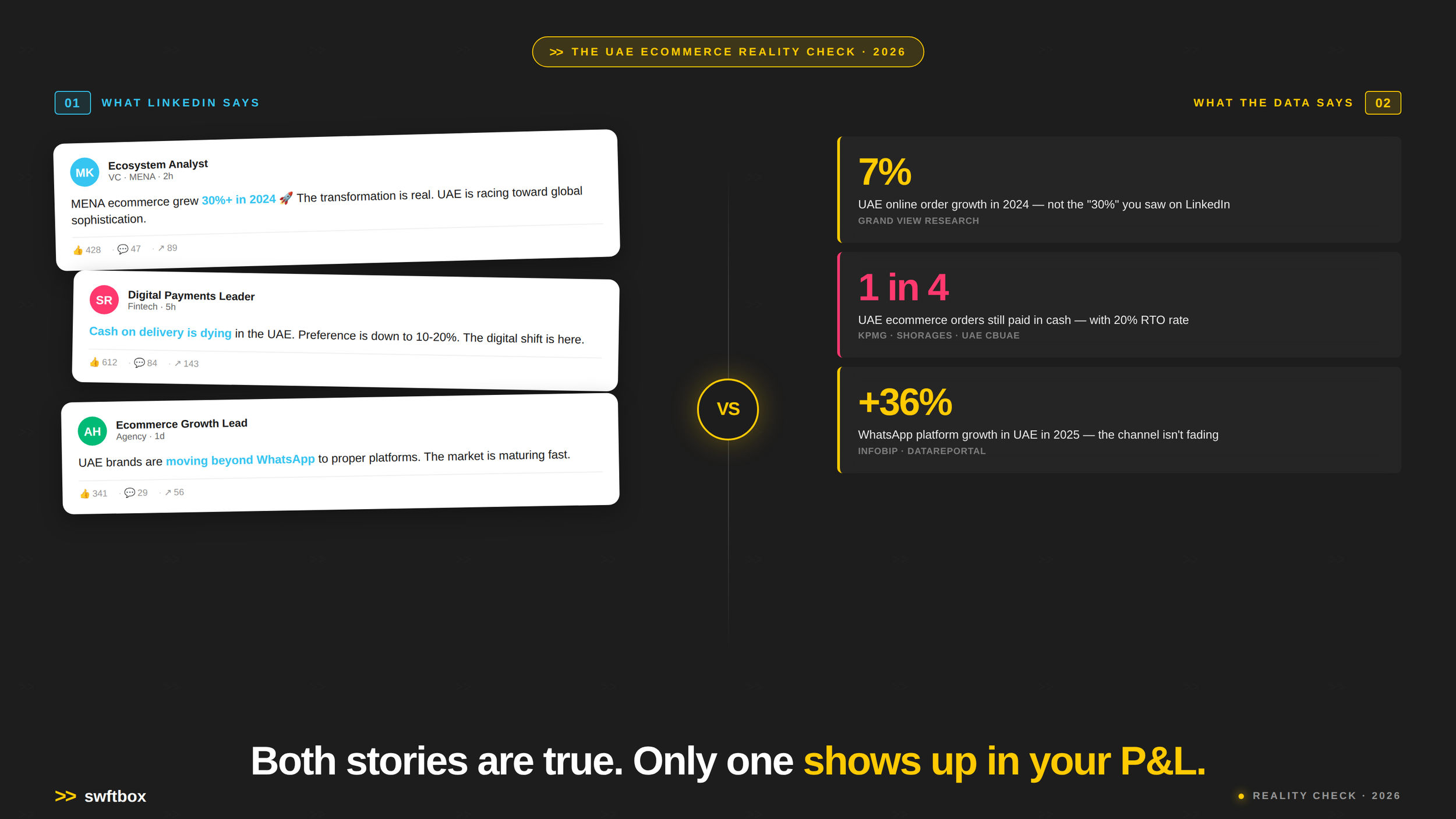
UAE e-commerce in 2026 is one of the most confidently-discussed and least-accurately-described markets in global retail. On LinkedIn, it's booming, digitizing, and racing toward global sophistication. In operational reality, one in three orders is still paid in cash at the door, one in five of those never gets delivered, and roughly half the country's e-commerce GMV runs through three companies.
Both stories are technically true. Only one shows up in your P&L.
This piece walks through what the data actually says about UAE e-commerce in 2026 — market size, COD, WhatsApp commerce, delivery operations, and funding — against the four narratives that dominate the region's public conversation. Every claim is sourced. Some of them will be uncomfortable.
How big is UAE e-commerce, really?
UAE e-commerce revenue estimates for 2025–2026 range from roughly US$7.5 billion (Statista, narrow B2C retail definition) to US$12.3 billion (Mordor Intelligence, broad definition including B2B and cross-border). The Dubai-government-backed EZDubai/Euromonitor number sits in the middle: AED 32.3 billion (~US$8.8bn) in 2024, forecast to reach AED 50.6 billion (~US$13.8bn) by 2029.
The spread isn't sloppiness. It's methodology. And it's the first reality check.
When someone quotes "the UAE e-commerce market," they're picking one of at least three definitions without saying which. That's a habit worth noticing, because the penetration story is where the LinkedIn narrative most cleanly breaks:
ECDB puts UAE e-commerce at 15–20% of retail in 2025, essentially flat into 2026. For comparison (Statista, September 2025): China sits at ~47%, the UK and South Korea at ~30%, the US in the mid-teens. The UAE is a mid-teens penetration market, not a "leapfrog to digital" market.
The UAE government itself acknowledges the gap. The Ministry of Economy's own retail and e-commerce page states plainly: "E-commerce penetration remains low, despite high internet and smartphone penetration in the UAE."
That single line — from the government, not a critic — contradicts most of what will be posted about UAE e-commerce this week.
Is UAE e-commerce booming, or are three companies booming?
The "MENA e-commerce boom" is real for headline GMV. It's much smaller for the average brand.
Bain & Company's "E-commerce in MENA: Opportunity Beyond the Hype" found that e-commerce pure players controlled over 90% of the MENA market — a level of concentration that has softened since but not fundamentally changed. Amazon.ae, Noon, and Carrefour together control roughly 45–50% of UAE GMV in 2025-26 (INTLBM/Mordor).
The SME layer is where the concentration story becomes visible:
SMEs are ~90% of registered MENA companies but contribute only 15–30% of GDP — compared to roughly 50% in developed markets (Bain / Think with Google).
Less than 20% of top global fashion brands physically present in MENA have locally-based e-commerce platforms offering regional delivery (Bain).
Contrast with the US, where roughly half of all items sold on Amazon come from more than a million SMEs (Bain).
The growth data reinforces the concentration story. According to Grand View Research's Holiday 2025 Playbook, MENA's e-commerce market grew over 30% in 2024 — but UAE online orders grew only 7% and Saudi 9% in the same period. The headline number is being pushed by rising average order values and a few mega-categories, not by broad participation.
Both "the market grew 30%" and "the average brand's order count grew 7%" are true. They describe entirely different businesses.
Is cash on delivery actually dying in the UAE?
Cash on delivery in the UAE is the clearest example of a narrative that measures the wrong thing.
The most-cited "COD is dying" figure comes from Checkout.com's State of Digital Commerce in MENA 2024, which reports that "over the past 48 months, the preference for cash on delivery in the region has halved from 41% to 20%," and that "in Saudi Arabia, UAE, and Kuwait, the preference for cash has dropped to as low as 10%."
That number is real. It also measures stated consumer preference in a survey — not share of actual orders.
The share of actual orders looks very different:
UAE Central Bank (2023 payment-systems research, as cited by Verified Market Research): roughly 40% of online transactions still use COD.
KPMG UAE retail research (cited by WebMedic): COD is 25–30% of transactions in 2026, down from 40% in 2022.
Shorages (fulfilment operator, own order data, June 2024): COD sits at ~30% of e-commerce volume.
Two things can be true. UAE shoppers, when asked, increasingly prefer cards. UAE shoppers, at checkout, still pay cash on one in every three or four orders. Preference is falling faster than behavior.
The gap between the two numbers is where merchants lose money.
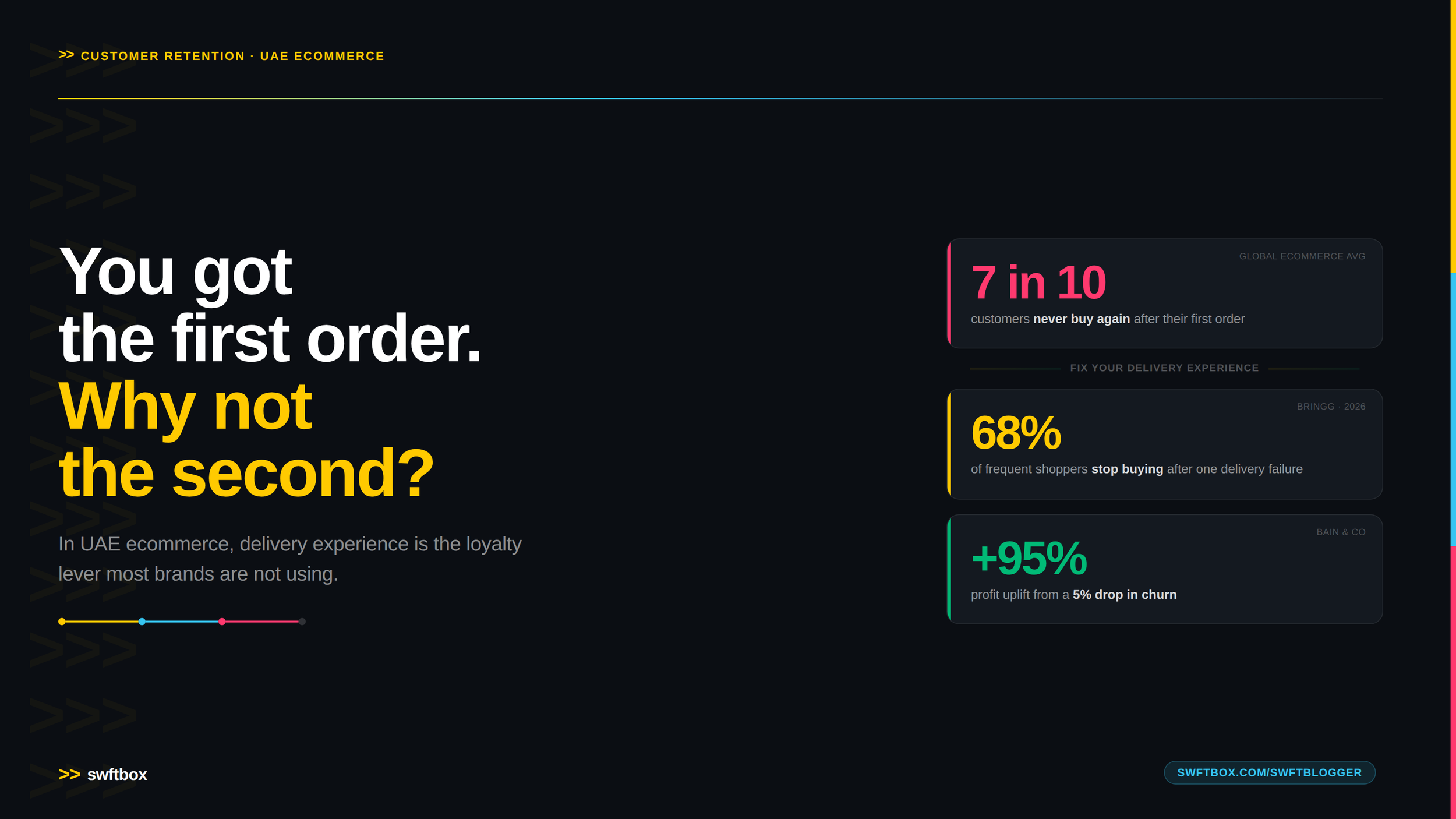
Shorages' own UAE order data shows ~20% of COD orders end in return-to-origin (RTO), against ~6% for prepaid orders. Quiqup's UAE data, cited widely across the industry, puts COD orders at roughly 12–13× the return rate of card-paid orders. Unmanaged COD-heavy stores routinely run RTO rates of 25–35% (industry reporting).
The unit economics compound quickly. Rejected COD orders cost roughly AED 25–50 each in shipping-both-ways and handling costs (Jeebly). And because COD cash sits in transit through collection, reconciliation, and settlement, brands with 25–30% COD RTO can have 3–5 weeks of revenue trapped in the system at any time.
The regional comparison sharpens the point. Estimated COD share of orders in 2026 (eGrow / CODRocket):
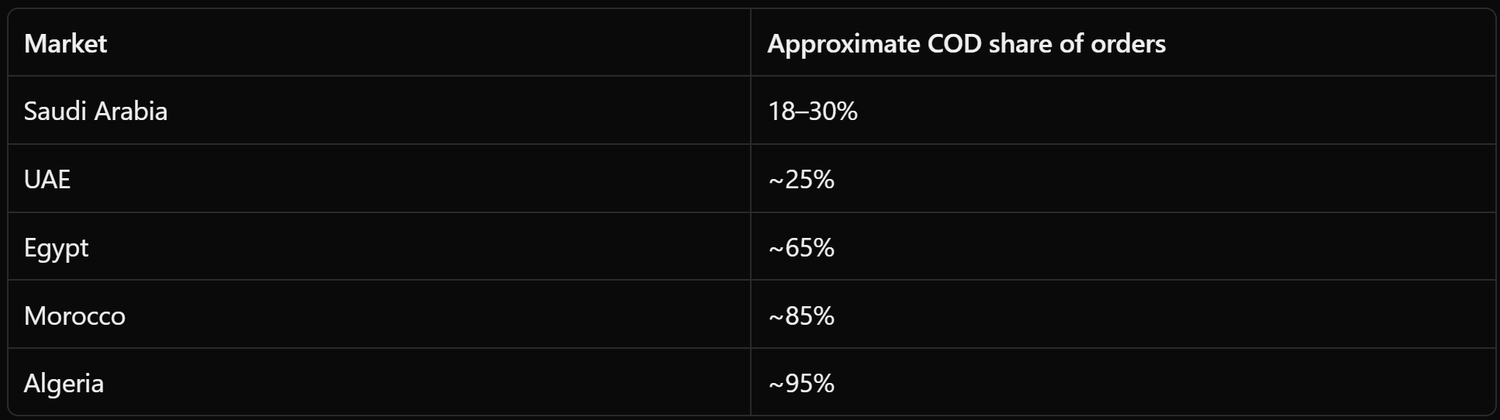
The UAE and Saudi have among the highest card penetration in the region — and card payments still account for only 65–80% of e-commerce transactions. COD isn't persisting because the rails don't exist. It's persisting because trust doesn't. Checkout.com's own 2024 MENA data shows 33% of MENA consumers report having been victims of payment fraud, and a third of MENA shoppers say a single failed payment would send them to a competitor.
COD didn't die. It went quiet. And it's still costing you money on every fourth order.
Have UAE brands really moved beyond WhatsApp and Instagram?
The narrative that UAE brands are "graduating" from WhatsApp and Instagram to proper e-commerce platforms describes a small population accurately and the majority incorrectly.
The numbers on the informal-channel side don't suggest a phase-out:
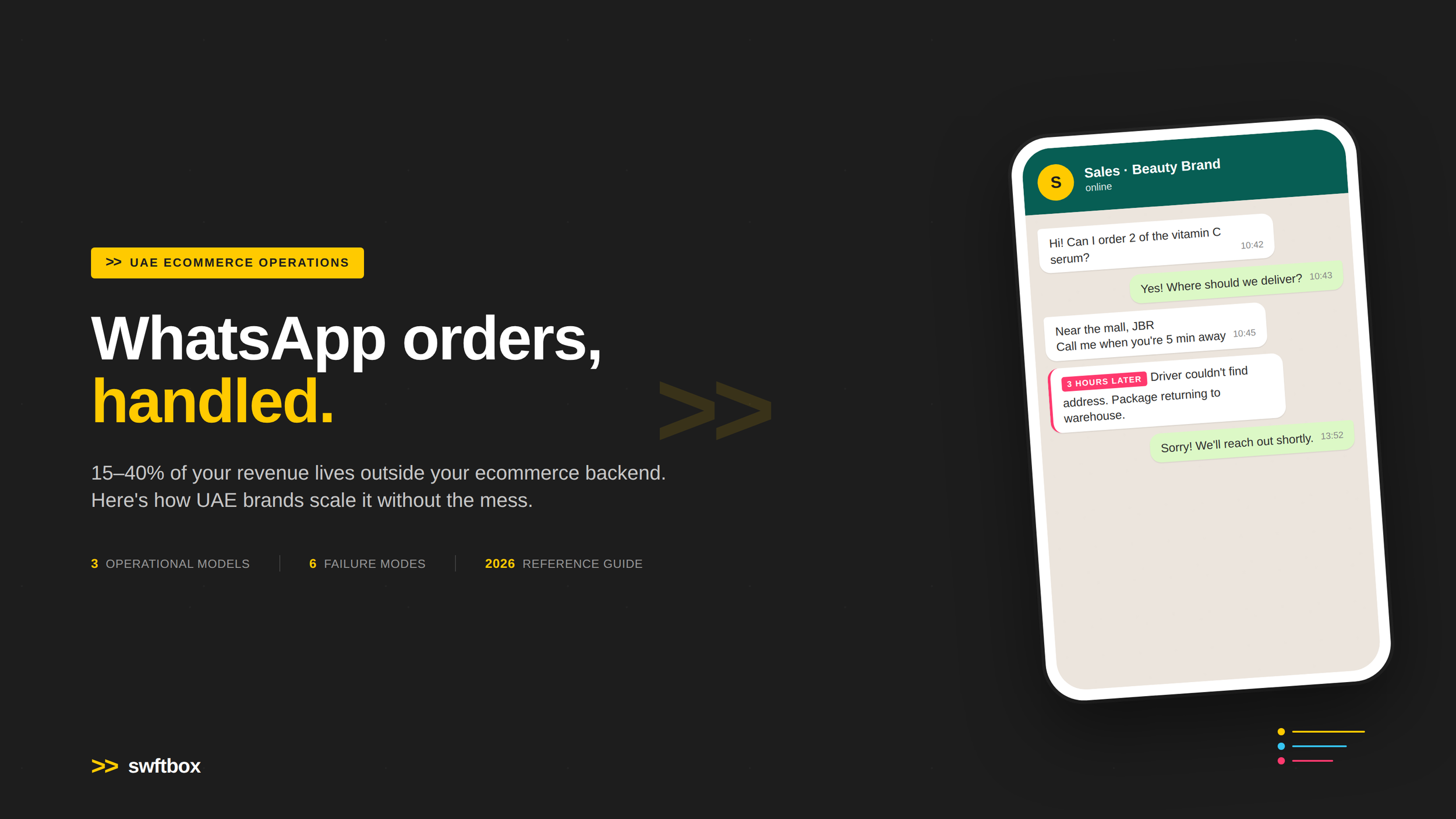
WhatsApp has ~90% penetration in the UAE, with 36% platform growth on Infobip's messaging infrastructure in 2025 alone (Infobip "WhatsApp statistics 2026").
UAE users spend approximately 15 hours 16 minutes per month on WhatsApp (DataReportal Digital 2026 UAE).
The UAE has approximately 11 million active social media users, or roughly 99% of the population (DataReportal / Kepios).
UAE social commerce is estimated at ~US$3.21 billion in 2024, projected to reach ~US$6.41 billion by 2030 (Panamedia); social commerce is growing at ~18.5% CAGR — faster than the ~11% growth in digital ad spend (GrabOn).
For UAE SMEs — 90% of registered companies but 15–30% of GDP — WhatsApp catalogs and Instagram DMs aren't the runway to a real e-commerce site. They are the e-commerce site. This isn't a temporary state. The channel is growing double digits.
For a fuller operational breakdown of how UAE brands are actually running WhatsApp commerce today, see the three operational models UAE brands use for WhatsApp orders.
Has the UAE actually caught up to global e-commerce sophistication?
This is the narrative with the widest gap between marketing and reality.
Start with addresses. The UAE has no traditional postal code system — "00000" is the universal placeholder used across e-commerce checkouts and logistics platforms. The Dubai Municipality's Makani system (10-digit geo-codes, live since 2015) is the workaround, but Makani numbers are assigned to building entrances, not individual units — a 40-floor apartment tower shares a single Makani number — and full coverage extends across Dubai and the northern emirates but not comprehensively nationally.
The US International Trade Administration's UAE e-commerce guide lists this explicitly as a structural barrier: "a lack of a unified address system which creates challenges for last-mile delivery."
That address gap has direct operational consequences. Nexdigm's UAE last-mile analysis notes that delivery in remote and northern zones can consume 15–25% of basket value, compared to 3–5% in dense urban hubs — meaning the "same-day everywhere across all 7 Emirates" promise is economically real primarily in the Dubai and Abu Dhabi urban cores.
Then there's returns.
UAE overall return rates run around 17%, with apparel at ~26% (Quiqup, 2025). By global comparison (NRF & Happy Returns "2025 Retail Returns Landscape," October 2025), the US e-commerce return rate is 19.3%, with total US retail returns at 15.8% of sales — approximately $849.9 billion in 2025. UAE headline return rates look comparable.
The infrastructure to handle those returns is where the gap opens. Reverse logistics remain thin. Instant refunds are unusual outside the largest platforms. Same-day return pickup — the sort of service that defines the returns experience in mature markets — is realistic primarily in Dubai and Abu Dhabi cores. The rates match global; the operational build-out doesn't.
For more on why returns are quietly becoming a bigger driver of UAE brand economics than most operators realize, see how UAE brands are handling returns as a profit center rather than a cost.
What does the funding data actually say about the ecosystem?
The 2025 funding headline was celebratory. MENA startups raised US$3.8 billion in equity across 688 deals, up 74% year-on-year — the strongest year on record according to MAGNiTT. Including debt, Wamda's tally reached approximately US$7.5 billion.
The 2026 first half told a different story.
MAGNiTT's State of Venture Capital: H1 2026 Review (via Arab News):
MENA funding fell 22% year-on-year to US$1.35 billion
Deal count dropped 41% to 214 — the lowest half-year since at least 2022
The 10 largest deals accounted for 58% of all funding
UAE captured US$895 million (66% of MENA total) — but over 60% of that flowed through just three BlueFive Capital-backed deals (CargoX $250M, Mal $230M, CNTXT AI $60M)
M&A exits fell 56% year-on-year to just 16 for the half — one of the weakest exit years on record
MAGNiTT CEO Philip Bahoshy noted that early-stage deals fell more than 50% year-on-year — "the truest measure of ecosystem appetite."
In logistics specifically, H1 2026 transport-and-logistics funding reached US$273 million — of which 92% was a single company (CargoX).
Layer this against the BNPL narrative: Tabby raised US$160 million at a US$3.3 billion valuation in February 2025 (later marked at approximately $4.5 billion in an October 2025 secondary transaction per Sacra). Tamara secured Saudi Arabia's first consumer-finance license from SAMA in March 2025. Both are real, meaningful raises.
But Termsheet's analysis of Tabby and Tamara's own numbers shows Saudi BNPL GMV growth decelerated on every measure in 2024 — the first simultaneous slowdown since BNPL launched in the region. Celebrated raises are not the same as ecosystem health.
The record 2025 raise was debt-inflated and top-heavy. 2026 is early-stage-frozen and exit-starved. Both facts co-exist. Only one shows up in LinkedIn recap posts.
Where does this leave UAE e-commerce founders in 2026?
None of this is an argument that UAE e-commerce isn't a real opportunity. The market is meaningful, the growth is real, and the government infrastructure supporting the sector is one of the strongest in the region.
But the operational gap the LinkedIn narrative papers over is precisely where the competitive advantage sits. If a third of your orders are cash, a fifth of those come back, your customer's address is "near the mall," and your returns desk is a WhatsApp thread — then operational execution is the entire business, not a downstream logistics detail.
The brands that win the next five years in UAE e-commerce won't be the ones with the loudest launch announcements or the biggest funding rounds. They will be the ones that quietly fix their first-attempt delivery rate, convert their COD share toward prepaid, tighten their reverse logistics, and treat their WhatsApp channel as first-class infrastructure rather than an accessory.
The hype is a distraction. The operations are the business.
For more on the operational decisions that separate scaling UAE brands from the rest, see the cross-border delivery cost model most UAE brands underestimate.
The bottom line
UAE e-commerce is a real, meaningful, and growing market. It is also concentrated, cash-heavy, WhatsApp-first, and operationally thin — in ways that don't show up in the growth charts and press releases.
Founders who accept both truths simultaneously can build defensible businesses. Founders who accept only the first will keep being surprised by what happens after the launch.
The LinkedIn narrative isn't lying. It's just measuring the wrong thing.
Ship with swftbox
Same day delivery, fulfillment and returns across the UAE.