WhatsApp orders are one of the largest and least-discussed parts of UAE e-commerce operations in 2026. Depending on category, WhatsApp accounts for 15% to 40% of order volume for UAE brands doing meaningful revenue — and almost none of them handle it the same way.
Most global e-commerce content ignores WhatsApp orders entirely. Global playbooks assume orders come through a website, a checkout, and an integrated backend. In the UAE that assumption is wrong for a meaningful share of every merchant's business.
This guide walks through what UAE e-commerce brands should actually do about WhatsApp orders in 2026: the three operational models most brands fall into, what breaks at each level, and the fixes that let a brand scale without leaving margin on the table.
Three-tier maturity model showing how UAE e-commerce brands typically handle WhatsApp orders in 2026, from informal personal WhatsApp with no system through semi-formal Business App with manual re-entry to fully integrated WhatsApp Business API with automated backend
Why do WhatsApp orders matter for UAE e-commerce brands in 2026?
WhatsApp orders matter because they represent real revenue that flows outside the systems most UAE e-commerce brands are built to manage.
For a typical UAE brand, WhatsApp orders come from four sources:
Instagram DMs redirected to WhatsApp to close the sale
Existing customers who prefer chatting over browsing
Repeat buyers placing reorders directly with a familiar staff member
Customers with questions who convert during the conversation itself
Each of these is a real order. Each contributes to revenue. And each enters the business through a channel that was never designed for e-commerce operations.
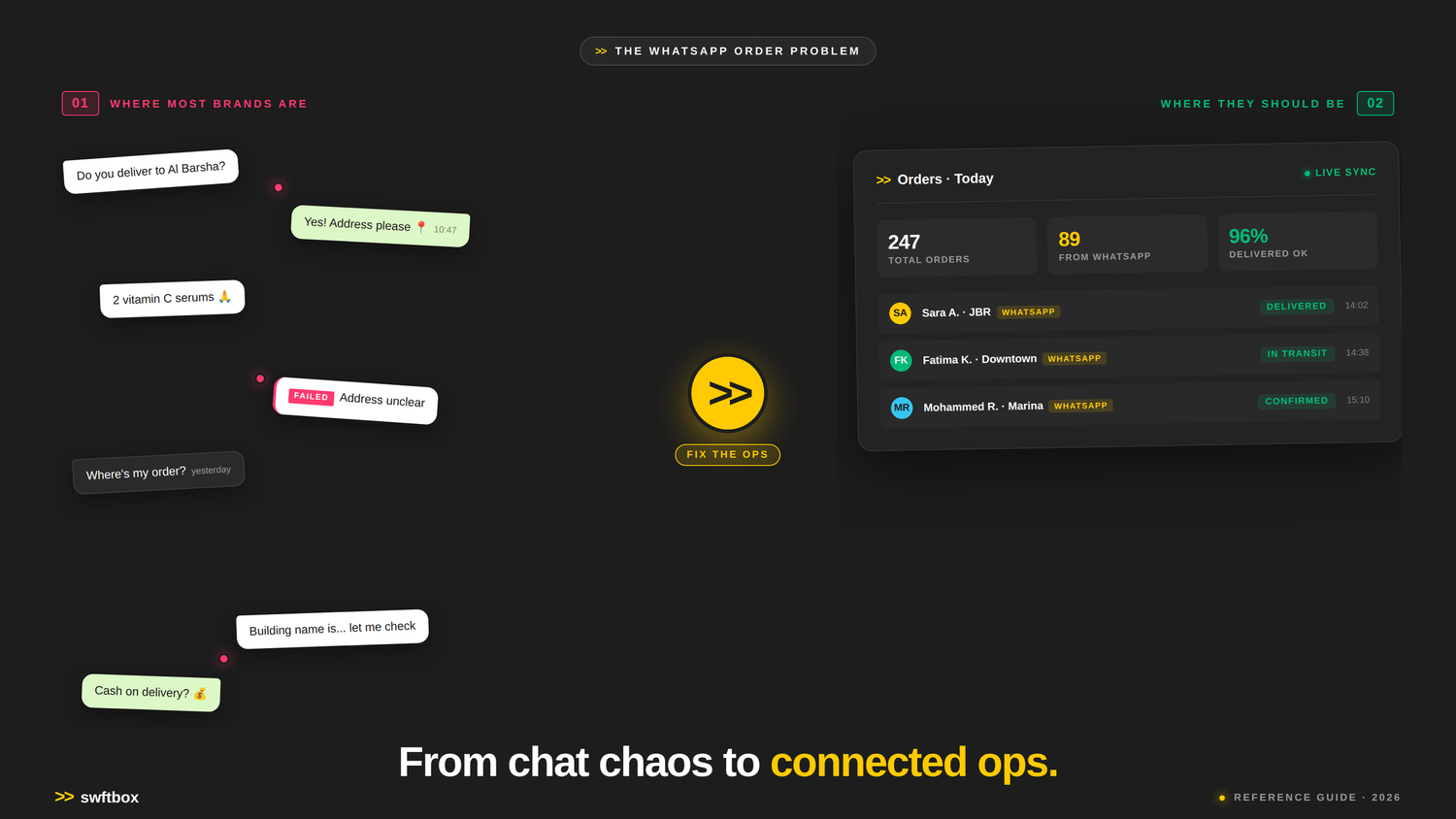
The result is that UAE brands often run two parallel businesses: the formal one through the website, and the informal one through the phone. The formal one has inventory tracking, order records, tax invoices, and delivery integrations. The informal one has WhatsApp screenshots.
That gap is where operational cost — and margin — quietly leaks. For a fuller breakdown of the checkout-quality issues that hurt UAE brand performance, see what UAE e-commerce brands still get wrong at checkout.
What are the three ways UAE brands handle WhatsApp orders?
UAE brands running WhatsApp commerce fall into three operational models, each with different implications for scale, cost, and customer experience.
Model 1: Informal (personal WhatsApp, no system)
The most common starting model. Orders come through a personal WhatsApp number. Staff writes them down. Someone dispatches the item — often physically hand-carried to a courier. Payment is typically COD, collected in cash, and reconciled at the end of the week.
There is no CRM record. No inventory tracking. No formal invoice. No integration with the delivery platform. The order exists only in the WhatsApp chat and, if you're lucky, in a spreadsheet.
This model works up to around 30 orders per month. Above 100 orders per month, it starts breaking silently.
Model 2: Semi-formal (WhatsApp business app + manual re-entry)
The most common model for growing brands. Orders come through a WhatsApp Business number. Staff manually re-enter each order into Shopify, WooCommerce, or a similar platform. From there, the order flows through the brand's normal fulfilment process — inventory adjustment, invoice generation, delivery booking, tracking notifications.
The customer never sees the platform side. From their perspective, they placed an order via chat and it arrived. But operationally, the brand runs its actual business through its e-commerce platform, with WhatsApp as a sales channel that funnels back into it.
This is the largest population of UAE brands doing WhatsApp commerce in 2026. It works — but it's labour-intensive, prone to error, and creates a bottleneck at the re-entry step.
Model 3: Formal (WhatsApp business API + integrated backend)
A minority model, typically adopted by brands doing significant volume or working with WhatsApp commerce platforms. The WhatsApp Business API connects directly to the brand's e-commerce backend. Orders placed through WhatsApp flow automatically into the platform. Inventory updates in real time. Invoices generate automatically. Delivery bookings happen without manual intervention.
Most UAE brands aim for this model eventually. Very few get there without first spending 12–18 months in the semi-formal middle.
What actually goes wrong with informal WhatsApp orders?
Informal WhatsApp orders break in six specific ways as brands scale. Each one costs real money.
No inventory reconciliation. When an order is fulfilled from stock without touching the e-commerce backend, inventory counts drift. The website shows 20 units; actual stock is 14. The brand keeps selling items it doesn't have. Cancellations and refunds follow.
No invoice trail for VAT compliance. UAE VAT law requires proper invoicing on e-commerce transactions above certain thresholds. Informal WhatsApp orders often bypass this, creating audit risk as brands cross registration thresholds. This is one reason the informal model becomes structurally unsustainable past a certain size.
No customer record for repeat marketing: A brand with a customer's WhatsApp number but no CRM record can't segment, re-target, or measure repeat behaviour. Growth becomes harder to model.
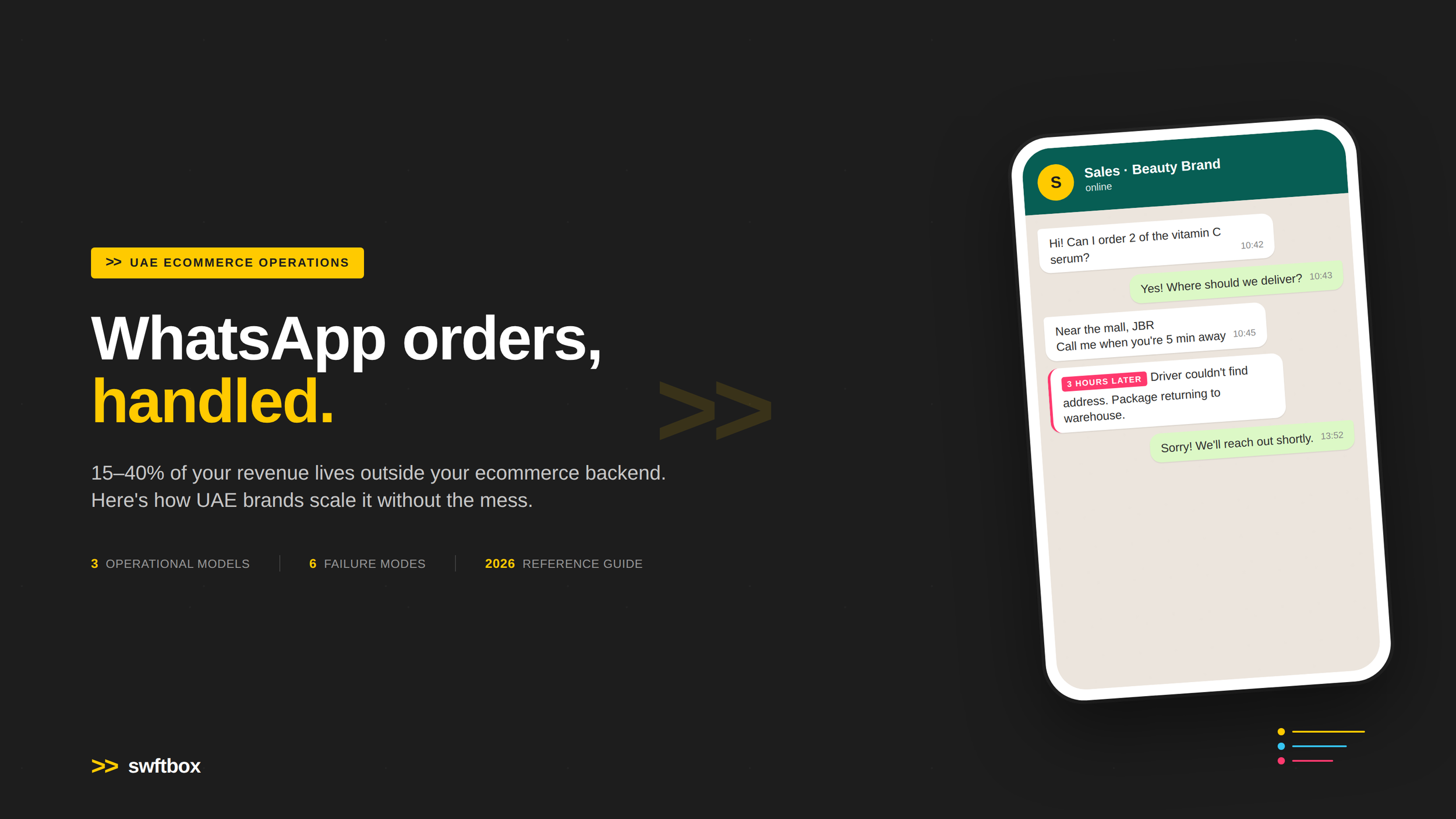
No delivery integration: Every WhatsApp order becomes a manual delivery booking. Address quality is typed from memory — or asked for a second time in chat, which is one of the most common causes of customer disengagement that leads to delivery refusal downstream.
No tracking or delivery notifications: The customer who ordered via WhatsApp expects updates via WhatsApp — but if the delivery isn't in the system, no automated notification fires. Staff has to manually message every customer with a delivery update. This does not scale.
No data on failures: When a WhatsApp order fails to deliver, there's no record of why. Without a system capturing these events, the brand can't identify patterns or fix root causes
What does the semi-formal model get right — and where does it break?
The semi-formal model gets the fundamentals right. Orders end up in the e-commerce platform. Inventory tracks. Invoices generate. Delivery integrates. The brand can measure repeat behaviour, calculate real unit economics, and comply with VAT properly.
Where it breaks is at the manual re-entry step.
Data entry errors: Staff transcribing an address from a WhatsApp message will make typing errors 4–8% of the time based on typical operational data. Each error becomes a failed delivery, a redelivery cost, or an RTO. For a brand doing 300 WhatsApp orders a month, that's 12–24 preventable failures per month directly caused by re-entry error.
Time cost per order: Manual re-entry takes 2–4 minutes per order at speed. At 300 WhatsApp orders a month, that's 10–20 hours of staff time monthly on data entry alone.
Timing bottleneck: Orders received on WhatsApp during off-hours accumulate until staff can process them. A customer who orders at 11pm may not be entered until 10am the next day — and the delivery clock only starts then. This creates the "why hasn't my order shipped yet" complaints that flood support the following day.
The semi-formal model is workable up to about 500 orders per month. Above that, the operational cost of manual re-entry starts exceeding the cost of proper integration.
How should UAE brands handle WhatsApp order delivery?
Regardless of which operational model a brand uses, three delivery-side decisions determine whether WhatsApp orders actually arrive successfully.
Decision 1: Address collection: WhatsApp is a bad interface for structured data collection. Customers type addresses however they want — sometimes with a Makani number, often without; sometimes with a building name, often with only "near the mall." Brands running WhatsApp commerce should have a standard address protocol staff follow when confirming every order: full building name, floor, apartment, Makani if available, mobile number verified with country code. This protocol should be enforced before the order enters the system, not after the delivery fails. For more on this, see why address quality is the silent driver of UAE last-mile economics.
Decision 2: Notification routing: Customers who order via WhatsApp expect updates via WhatsApp. If the brand's delivery platform sends SMS or email notifications, the customer often misses them — or gets confused by the mismatch between channels. Delivery notifications for WhatsApp orders should ideally route back to WhatsApp itself. This is technically possible in Model 3 and workable in Model 2 through third-party notification tools.
Decision 3: Payment reconciliation: Informal WhatsApp orders often use COD not because the customer chose it but because it's the only option offered. Every COD order carries a 12–20% refusal risk at the doorstep in the UAE. Brands should offer payment links as the default — sent as part of the order confirmation — and reserve COD for customers who specifically request it. This one change materially reduces failure rates.
When should UAE brands upgrade from one model to the next?
The upgrade points are volume-driven, but the real triggers are operational.
Move from Model 1 to Model 2 when:
Monthly WhatsApp orders exceed 50 and are growing
Inventory reconciliation is drifting between the platform and reality
The brand is approaching or has crossed the UAE VAT registration threshold
Customer support is spending meaningful time on "where's my order" queries
Failed deliveries are increasing and the brand can't identify why
Move from Model 2 to Model 3 when:
Monthly WhatsApp orders exceed 500 and are growing
Manual re-entry is consuming more than 10 hours of staff time per week
Data entry errors are causing measurable delivery failures
The brand is scaling; new markets, new categories, larger team and the WhatsApp bottleneck is limiting speed
Model 3 requires either a WhatsApp Business API integration through Meta's official partners or a WhatsApp commerce platform that bridges the two systems. Neither is free, but at 500+ monthly WhatsApp orders, the payback period is typically under six months in staff time alone.
What are the most common WhatsApp commerce mistakes UAE brands make?
Five recurring mistakes account for most of the operational cost UAE brands incur from WhatsApp orders in 2026.
Treating WhatsApp as a separate business: The most expensive mistake. WhatsApp orders should feed the same backend, inventory, delivery flow, and customer database as web orders. Treating them as parallel guarantees the parallel operation gets weaker over time.
Not standardizing the order confirmation script: Every WhatsApp order should be confirmed with a standard structure: item, quantity, delivery address (validated), preferred delivery time, payment method, order reference. Without a script, staff improvise — and orders lose information that shows up later as a failed delivery.
Skipping the payment link: Defaulting to COD because "the customer prefers cash" is often a self-fulfilling prophecy. Offering a payment link as the default and framing COD as an alternative shifts many customers to prepaid, cutting refusal risk sharply.
Not measuring the WhatsApp channel separately: If WhatsApp orders are mixed into total order metrics without a channel tag, the brand can't see whether WhatsApp customers behave differently — different AOV, different repeat rate, different failure rate. All of these are usually meaningfully different.
Delaying the upgrade past its breaking point: Every model transition has a moment where the pain of upgrading is less than the pain of staying. Most UAE brands wait 6–12 months past that moment.
What should UAE brands verify before scaling WhatsApp commerce further?
Before scaling WhatsApp commerce further, verify:
WhatsApp orders enter the same e-commerce platform as web orders
Inventory reconciles automatically or within 24 hours of the order
Every WhatsApp order generates a proper invoice for VAT compliance
Address collection follows a standard protocol enforced at order confirmation
Delivery notifications route back to WhatsApp where the customer originated
Payment links are offered as the default; COD is opt-in, not automatic
WhatsApp channel is tagged separately in reporting for cohort analysis
Volume triggers for model upgrade (50 and 500 orders per month) are being monitored
Staff has a standard order confirmation script
Failed delivery reasons are captured and reviewed monthly
Where does this leave UAE e-commerce brands in 2026?
WhatsApp orders are not going away in UAE e-commerce. If anything, WhatsApp commerce is growing as a share of total UAE e-commerce revenue in 2026, particularly among mid-market brands and in categories like beauty, fashion, F&B, and home.
The brands that handle WhatsApp orders well aren't the ones that ignore the channel or treat it as an unfixable operational mess. They are the ones that name the model they're using today, identify where it breaks, and plan the upgrade path before it becomes urgent.
Most UAE brands underestimate how much of their operational cost — and their delivery failure rate — traces back to WhatsApp orders being handled in ways that don't scale. The fix is structural, not tactical. And the earlier a brand builds it, the less it costs to build.
For more on how brands can structure their delivery operations to scale, see the delivery experience decisions that actually move customer loyalty.
Ship with swftbox
Same day delivery, fulfillment and returns across the UAE.