
How to Reduce Last-Mile Delivery Costs in UAE Ecommerce (2026)
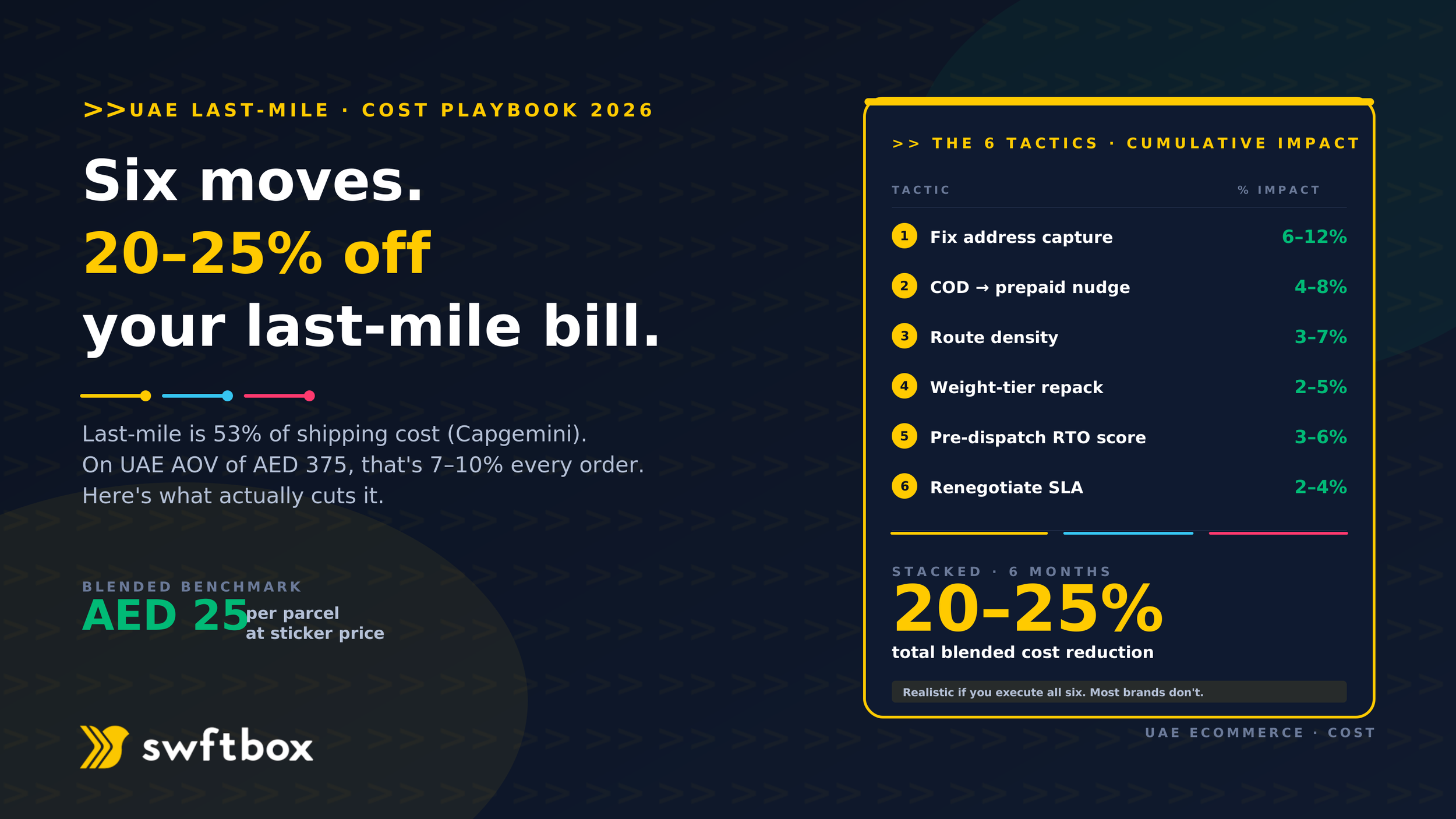
Last-mile delivery is 53% of total shipping cost and 41% of end-to-end supply-chain cost, according to the Capgemini Research Institute. For a UAE ecommerce brand operating at the average 2024 order value of AED 375 (ECDB UAE benchmarks), that translates to 7–10% of every order at sticker price — and 10–14% once you factor in failed-attempt retries and RTO.
That's the single largest fixable line on your P&L. It's also where most UAE brands over-pay because they negotiate the wrong number.
This piece skips the generic advice ("automate!") and gives you the six tactics that actually move UAE delivery cost per parcel — with the real AED math, the expected % impact, and the order to attack them. Every claim is sourced at the bottom.
The framing pairs with our last-mile delivery cost breakdown. This piece is what to do about it.
What actually drives last-mile delivery cost in UAE ecommerce?
Six cost drivers stack on every parcel. Understanding the mix is the first tactic — because most UAE brands negotiate the wrong line.
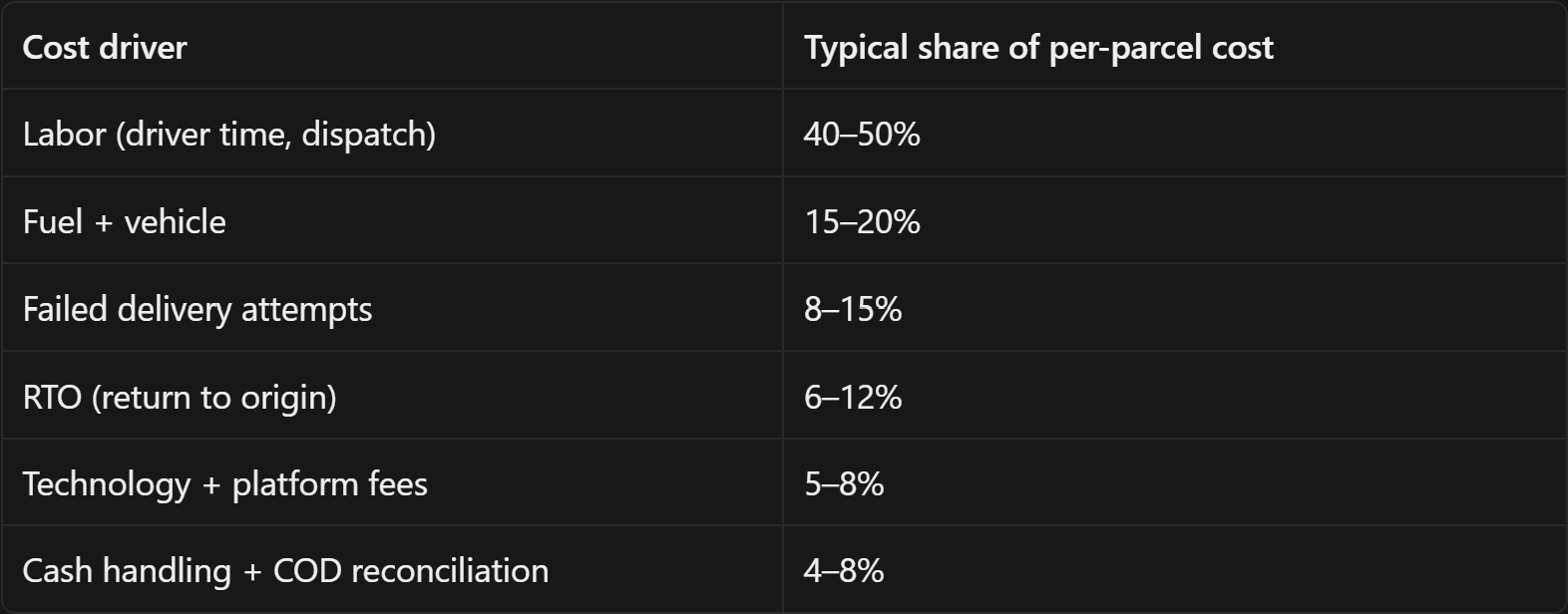
Two lines here are usually mispriced by merchants: failed attempts and RTO. Together they typically account for 15–25% of your true per-parcel cost, but almost no brand tracks them as a separate P&L line. Fixing them is where the fastest gains live.
What’s the Typical Last-Mile Cost per Parcel in UAE E-commerce?
For 2026, realistic UAE last-mile delivery costs vary significantly by delivery speed and location. In Dubai, standard next-day delivery typically costs around AED 17–30 per parcel, while rates in the Northern Emirates are generally higher at AED 22–38. Same-day delivery typically ranges from AED 35–60 in Dubai and AED 45–75 in the Northern Emirates. For faster 2–4 hour bullet or express delivery, merchants can expect approximately AED 55–90 per parcel, although availability is more limited outside major urban areas. Cross-border delivery from the UAE to Saudi Arabia typically falls around AED 40–65, with Northern Emirates shipments reaching approximately AED 45–75.
For a merchant processing 1,000 monthly orders with an 80/20 mix of next-day and same-day deliveries, the blended delivery cost is roughly AED 25 per parcel at sticker price. Against a UAE average order value (AOV) of AED 375, that represents approximately 6.7% of AOV. However, the headline courier rate is only part of the picture. Once failed delivery attempts, retries, and amortized return-to-origin (RTO) costs are included, the true delivered cost can rise to approximately AED 32–38 per order, or 8.5–10% of AOV. For UAE e-commerce retailers, an effective last-mile cost consistently above 12% of AOV should be treated as a signal to investigate delivery efficiency, address quality, route density, failed deliveries, RTO rates, and courier SLAs rather than simply accepting higher delivery rates.
How much does a failed delivery attempt actually cost you?
A failed first attempt in the UAE costs 1.6x to 2.2x the successful-delivery cost of the same parcel. That's the multiplier most merchants under-price.
The stack: original attempt cost is sunk, retry attempt cost is added, customer-service handling adds 10–20 minutes of agent time, and if the retry fails the RTO cost triples the total.
Worked example, standard next-day parcel in Dubai:
Base cost: AED 22.
Failed first attempt + one retry: AED 22 + AED 22 + AED 6 CS overhead = AED 50.
Failed retry → RTO: AED 22 + AED 22 + AED 22 return leg + AED 6 CS = AED 72, plus lost product margin.
If your first-attempt success rate is 85% (typical for UAE brands not focused on address quality), that means 15 out of every 100 parcels are running at 2–3x cost. The math compounds fast — and it's mostly recoverable.
What are the 6 highest-leverage tactics to cut UAE last-mile cost?
Ordered by expected % impact per effort-day. Do them in this order.
1. Fix address quality at order capture
Expected impact: 6–12% total last-mile cost reduction.Effort: low. Payback: 30–60 days.
Most UAE addresses are informal — "villa near the mosque behind the mall." That single-line freeform description is why first-attempt success rates hover around 85% instead of 95%. Force structure at checkout: separate fields for area/community, building, floor, apartment/villa, and Makani number. Add a live map picker for coordinates. Require a WhatsApp number.
We break down the operational cost of bad addresses in the address quality piece. This is the single-highest-return fix on the list.
2. Convert COD orders to prepaid where possible
Expected impact: 4–8% total last-mile cost reduction.Effort: low. Payback: 30 days.
COD parcels cost more to deliver, refuse more often, and reconcile slower. Even a small conversion from COD to prepaid — 15–20% of your COD volume — swings margin materially. Tactics that work in UAE: 5–10% discount on prepaid, faster delivery promise for prepaid, "pay AED 1 to reserve" mini-deposit patterns.
Every prepaid conversion also removes a refusal risk, which quietly compounds the saving.
3. Drive route density
Expected impact: 3–7% cost reduction.Effort: medium (needs carrier alignment). Payback: 60–90 days.
Density is the operational lever. A driver making 45 drops in a 5 km radius costs a third per parcel of a driver making 15 drops across 30 km. UAE brands can drive density with: cutoff-time nudges ("order by 3 PM for tomorrow"), postcode/emirate-based promise variability, and geographic clustering of your marketing campaigns.
For brands >2,000 monthly parcels, this is worth actively managing. Below that, your carrier's dispatch does it for you (or fails to).
4. Optimize the weight tier you're paying
Expected impact: 2–5% cost reduction.Effort: low. Payback: 15 days.
Every UAE 3PL contract has weight tier boundaries — usually 500g, 1kg, 2kg, 5kg. A parcel weighing 1.02kg pays the same rate as one weighing 1.99kg. Audit your top 20 SKUs. If 15% of them are just over a tier boundary, repackaging into smaller / lighter materials can drop half your parcels a tier. That's a direct AED-per-parcel saving with zero operational risk.
5. Reduce RTO before dispatch, not after
Expected impact: 3–6% cost reduction.Effort: medium. Payback: 60 days.
RTO is treated as a returns problem. It's actually a filtering problem. Score every order at capture: address quality, phone risk (VoIP vs SIM), COD flag, order value, category. Flag risky orders for a WhatsApp confirmation ping before you dispatch. UAE brands doing this cut RTO on flagged orders by 12–20%.
Not every carrier supports this workflow. Ask yours whether they do.
6. Renegotiate SLA structure, not just per-parcel price
Expected impact: 2–4% cost reduction.Effort: high (renegotiation cycle). Payback: 90–120 days.
Most UAE 3PL negotiations focus on per-parcel price. That's the wrong lever after a certain volume. Bigger wins: first-attempt SLA penalties (does your carrier eat cost on failure?), transparent RTO surcharge schedule, weight-tier gaming clauses, minimum-volume commitments with flex bands, and end-of-year rebate tiers.
A well-structured SLA at flat per-parcel price beats a "cheaper" price with hidden RTO and re-attempt surcharges every time.
Which tactics have the fastest payback?
Combined view for prioritization. If you can only do three things this quarter, do the top three.
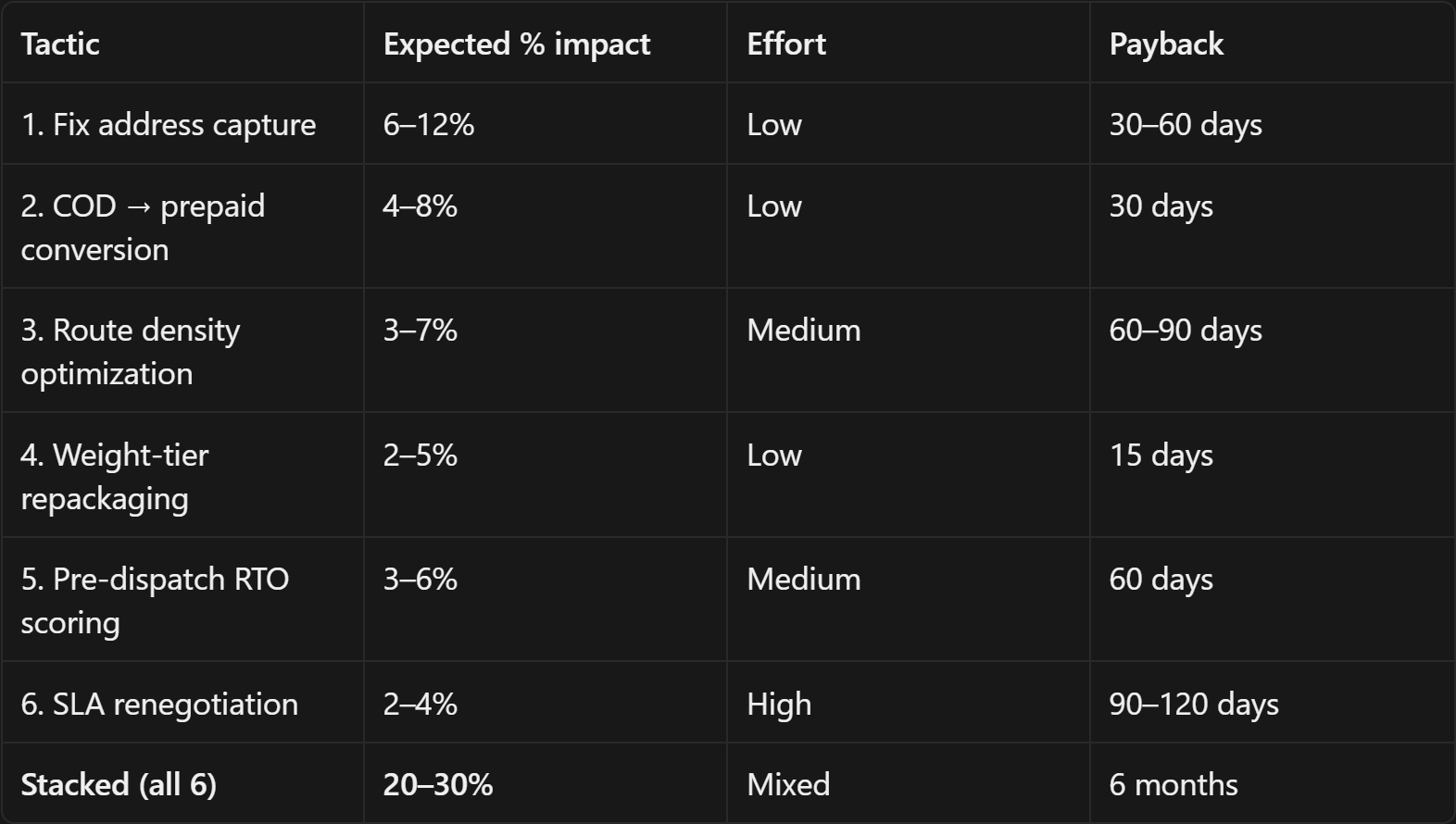
Realistic total: 20–25% reduction in blended UAE last-mile cost per parcel within six months if you actually execute all six. That's 2–3 percentage points of margin back to the P&L on a typical UAE ecommerce brand.
What are UAE ecommerce brands NOT doing that they should?
Three things, from the operator side.
They don't track failed-attempt cost as a separate line: Failed attempts get bundled into "delivery cost" and vanish. Track them separately, and you'll notice the leak.
They don't renegotiate contracts on structure, only on price: Vendors know this — that's why the sticker price is competitive but the surcharges eat you. The savings live in the fine print, not the header rate. We covered a real example in our cross-border cost case study.
They don't measure cost per successful delivery — only cost per shipment: These are different numbers. A parcel that fails twice before delivering successfully cost you 2.6x sticker price. Only cost-per-successful-delivery tells you what's actually happening.
Fix these three measurement gaps and the six tactics above stop being theoretical.
