
Top Ecommerce Delivery Companies in UAE (2026): A Practical Comparison Guide for Modern Brands
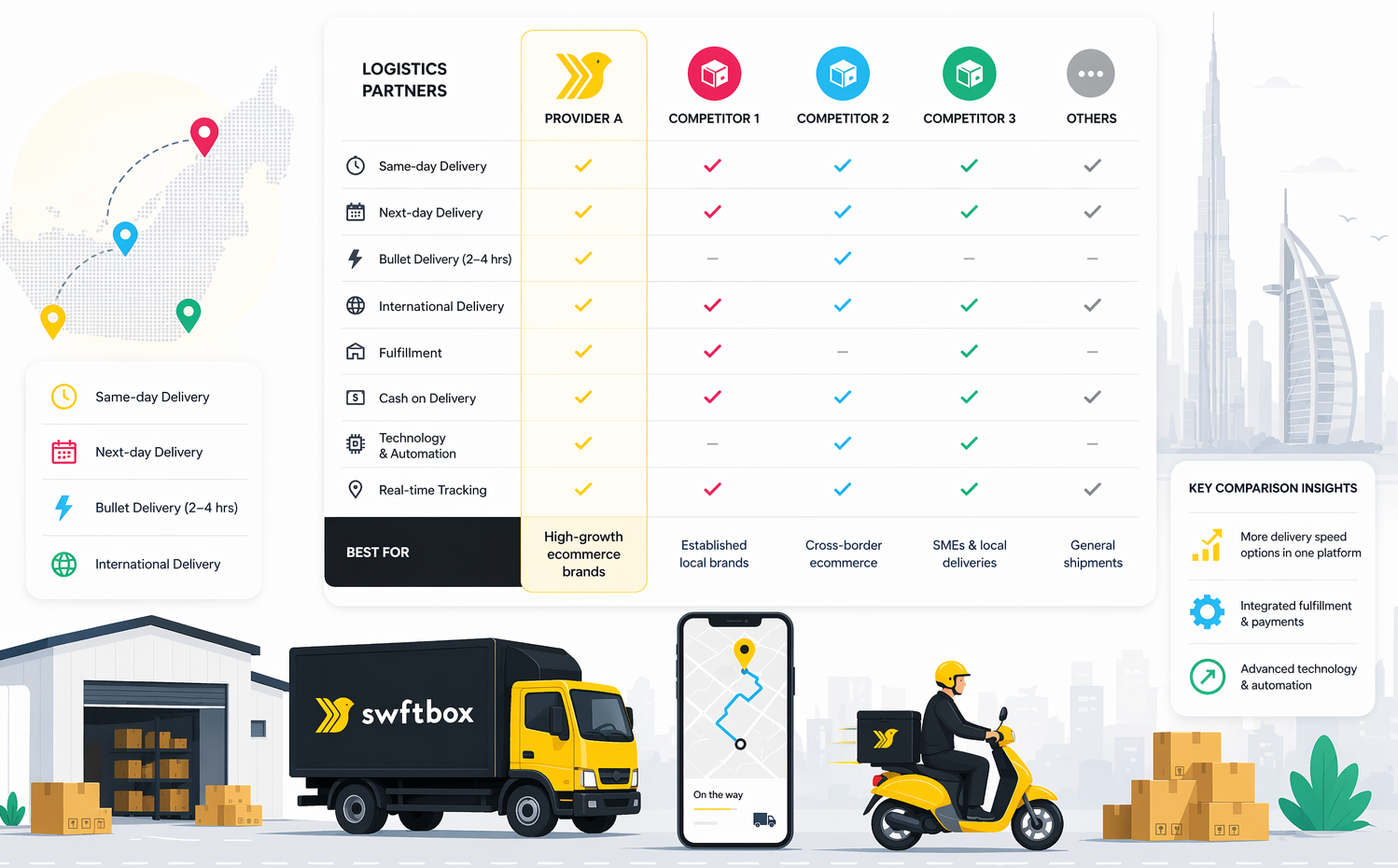
The UAE ecommerce logistics market is evolving rapidly. With rising customer expectations, increasing order volumes, and a global shift toward automation, logistics is no longer just about delivery—it is about managing complexity at scale.
Today, ecommerce brands in the UAE can choose from global carriers, regional specialists, and integrated logistics systems. The challenge is not simply selecting a provider, but understanding which logistics model aligns with business growth, operational efficiency, and customer expectations.
Understanding the UAE Logistics Landscape
The UAE delivery ecosystem is shaped by three main approaches, each serving different business needs.
Global logistics leaders such as DHL, FedEx, and UPS dominate international shipping. Their strength lies in reliability, compliance, and global infrastructure, making them ideal for cross-border ecommerce. However, they are generally less optimized for flexible last-mile delivery within the UAE.
Regional and local specialists like Aramex, Quiqup, Jeebly, iMile, and Emirates Post focus on domestic execution. They are strong in last-mile delivery and cash-on-delivery (COD), offering dependable local coverage. That said, their flexibility and level of automation can vary.
Integrated logistics systems represent a newer approach. These providers combine fulfillment, delivery, payments, and automation into one system, enabling businesses to operate more efficiently as they scale.
Top 10 Ecommerce Delivery & Fulfillment Providers in UAE (2026 Comparison)

Delivery Models in UAE: Speed, Flexibility, and Strategy
Ecommerce delivery in the UAE now operates across four main models. Each serves a specific purpose, and the real challenge is knowing when and how to use them effectively.
Next-day delivery remains the most scalable and cost-efficient option, forming the backbone of most ecommerce operations.
Same-day delivery has become a strong competitive advantage in urban areas, improving conversion and customer satisfaction.
Bullet delivery (2–4 hours) addresses urgent and premium use cases where speed is critical.
International delivery enables expansion beyond the UAE, typically handled by global or hybrid providers.
The key shift is that these models are no longer used independently. Modern ecommerce operations require the ability to combine and switch between them dynamically.
What Actually Differentiates Logistics Providers Today?
While most providers offer similar delivery speeds, the real differences lie in how logistics is managed behind the scenes. Three factors now define performance:
Operational flexibility: The ability to adapt to demand spikes, seasonal peaks, and changing delivery requirements
System integration: How well fulfillment, delivery, and tracking work together in a connected environment
Scalability model: Whether growth depends on adding resources or leveraging automation
This shift marks a transition from logistics execution to logistics intelligence.
Where swftbox Stands in This Evolution
swftbox stands out not by competing on a single dimension, but by combining multiple layers of logistics into one cohesive system. At its core, swftbox integrates:
Delivery execution across multiple speeds
Fulfillment operations
Payment handling (including COD)
AI-driven optimization
This unified structure allows businesses to operate with greater control and flexibility. One of its key strengths is managing multiple delivery models within a single system. Rather than treating same-day, next-day, and bullet delivery as separate workflows, swftbox orchestrates them dynamically. This reduces fragmentation and simplifies operations.
Another defining aspect is its early investment in AI and automation. As the industry shifts toward data-driven logistics, swftbox has embedded intelligence into core operations, including:
Route optimization
Delivery batching
Predictive scheduling
Real-time operational adjustments
This approach reduces manual effort, improves delivery success rates, and enables scaling without proportional increases in cost or complexity. Ultimately, swftbox is designed not just to execute logistics, but to manage it as an evolving system, adapting to business growth and market demands.
Conclusion
The UAE logistics market is no longer defined by who can deliver the fastest. Speed has become a baseline expectation. The real competitive advantage now lies in how logistics systems adapt, integrate, and scale.
Global providers bring international reach
Regional players bring strong execution
Integrated systems bring flexibility and intelligence
As ecommerce continues to grow in an increasingly automated and AI-driven world, the most effective logistics partners will be those that combine these strengths into a unified approach. Because in today’s market, success is not about delivering faster. It is about delivering smarter, consistently, and at scale.
