
Dubai Customs Just Raised the Cross-Border Duty-Free Threshold to AED 1,000: What It Means for UAE Ecommerce?
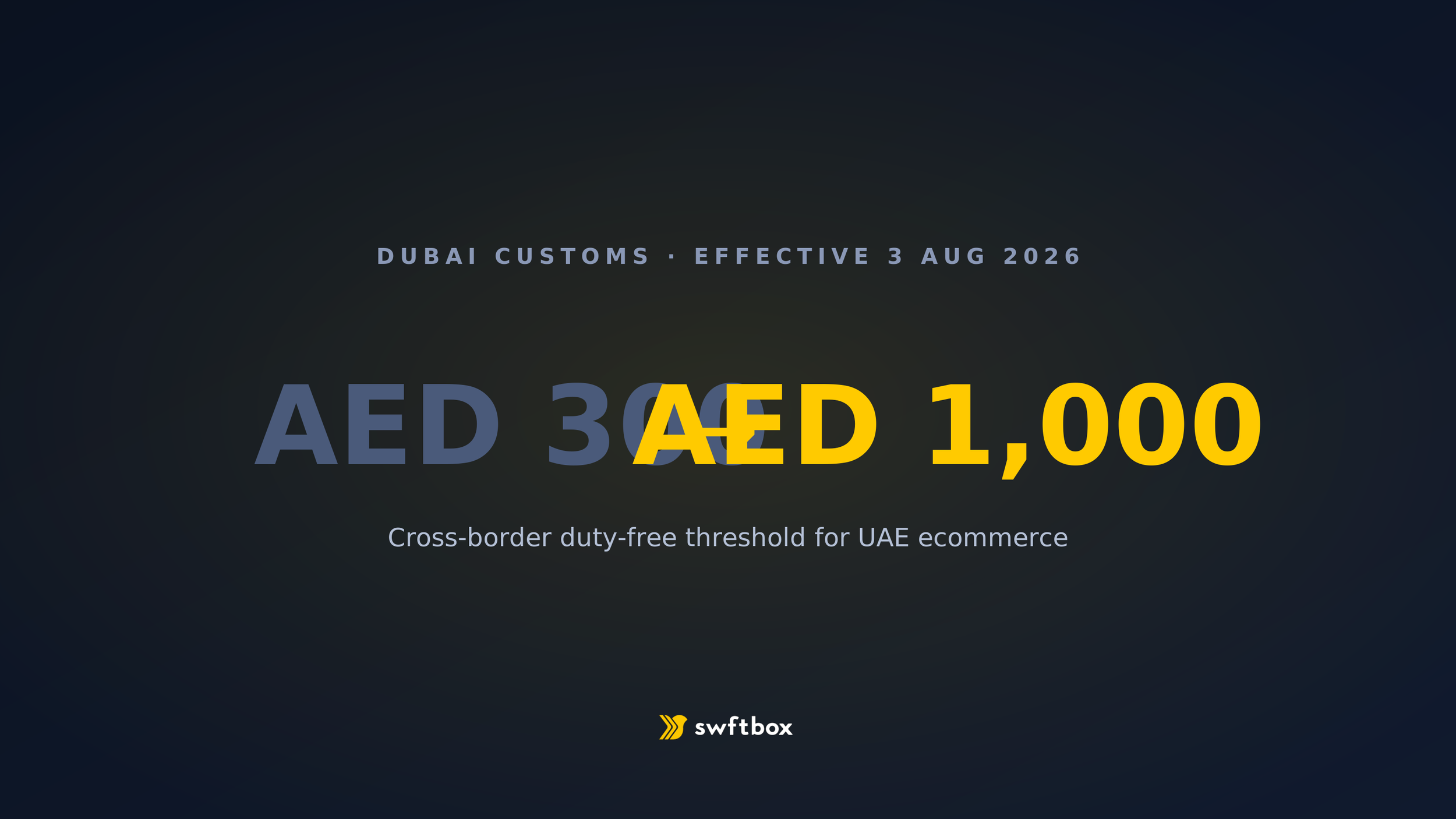
On 3 August 2026, Dubai Customs Notice No. 16 of 2026 came into effect. Cross-border e-commerce shipments valued at up to AED 1,000 are now exempt from customs duty — up from the AED 300 de minimis Dubai has enforced since 1 January 2023. B2C returns get a longer, duty-neutral window: 60 days from date of exit.
For UAE Shopify merchants importing SKUs, selling internationally, or handling returns from cross-border buyers, this is the biggest landed-cost reset in three years. But there's a trap: the exemption removes duty, not VAT — and every "we're now duty-free" pitch you'll see from freight forwarders in the next 60 days conveniently forgets that.
Companion to our customs clearance guide and last-mile cost breakdown.
What did Dubai Customs actually change?
Two things. First, Dubai raised the duty-free threshold for cross-border e-commerce shipments from AED 300 to AED 1,000 per parcel. Second, B2C returns on which duty was already paid are now duty-exempt if the goods leave the country within 60 days of their original exit date.
The change was published as Notice No. 16 of 2026, effective 3 August 2026. Dubai Customs framed it as part of a broader push to reduce costs for the ecommerce sector and attract cross-border investment.
The rules apply to Dubai — not automatically UAE-wide. Merchants clearing through Abu Dhabi, Sharjah, or the northern emirates should verify with their carrier which port of entry their parcels use.
What's excluded from the AED 1,000 exemption?
Four product categories. If any of these are in your catalogue, treat the exemption as if it doesn't exist for those SKUs. The exclusions per the Khaleej Times report on the notice:
Tobacco and tobacco products
Electronic smoking devices, their equipment and accessories
Liquids containing nicotine
Alcoholic beverages, or food preparations containing alcohol
These categories carry 50% duty on alcohol and 100% on tobacco at any value, so the exclusion is expected but worth stating in your merchant workflow.
Does the exemption remove VAT too?
No. It removes the 5% customs duty. The 5% import VAT still applies on any dutiable import — that's the trap most social-media summaries miss.
Here's the math on a AED 800 cross-border parcel (a mid-priced fashion or electronics order) before and after Notice 16/2026, assuming CIF value of AED 800 + AED 40 freight = AED 840 CIF:
ComponentBefore 3 Aug 2026After 3 Aug 2026Customs duty (5% of CIF)AED 42AED 0Import VAT (5% of CIF + duty)AED 44.10AED 42.00Total taxesAED 86.10AED 42.00
Landed-cost saving: AED 44 per parcel on an AED 800 order — roughly 5.5% of sticker price back to your margin or your customer.
Extend that across 500 monthly cross-border parcels averaging AED 800 and you save roughly AED 22,000/month in duty on eligible shipments — meaningful, but nowhere near the "duty-free" impression the phrase creates. VAT is roughly half of the pre-3-August tax load, and it stays.
The 5% duty rate applies to CIF (Cost + Insurance + Freight), so on lower-freight parcels the saving compresses proportionally.
How does the 60-day returns rule change ecommerce operations?
Under the old regime, cross-border returns cleared through customs as a fresh import — duty and VAT re-triggered on the same goods you'd already cleared. The new rule exempts already-duty-paid B2C goods from a repeat duty charge if the parcel exits within 60 days of its original exit date.
For UAE Shopify merchants selling into the GCC or globally, this is a working-capital shift. A merchant with a 24.5% global ecommerce return rate running 1,000 monthly cross-border orders books ~245 returns per month. If ~40% of those previously incurred re-cleared duty (mid-value parcels that crossed the old AED 300 threshold), that's ~100 parcels/month × roughly AED 40 in re-cleared duty = ~AED 4,000/month in returned-parcel duty recovered — provided the returns are pushed through within the 60-day window.
The operational cost is workflow: your reverse-logistics vendor needs to date-stamp exit and prove duty paid. Merchants running informal returns processes (accepting returns via WhatsApp, manual approvals) will miss the window on a meaningful share of them.
Modeling assumptions
Three inputs above are estimates for a mid-mix UAE Shopify merchant: (1) the 40% share of returns that historically re-triggered duty, (2) the AED 800 average cross-border parcel value, and (3) the AED 40 average freight per parcel. Fashion is higher-return; electronics is lower-return but higher-value. Adjust to your own catalogue before quoting these numbers to a stakeholder.
What should UAE Shopify merchants change this week?
Six actions, in order of impact.
Update your landed-cost calculator: Any dashboard, checkout plugin, or spreadsheet that still adds 5% duty on cross-border shipments up to AED 1,000 is now overstating landed cost by exactly the duty amount. Fix the formula before your finance team quotes the wrong number in a pricing meeting.
Reprice or reallocate the margin: You now have ~5% of pre-tax landed cost back on every eligible parcel. Decide: absorb it as margin, drop retail price to become more competitive, upgrade to premium delivery, or bundle a free-returns promise. Don't let it silently vanish into finance.
Rewrite the checkout copy: If your product pages, cart, or checkout say "customs duties may apply on international orders," update the wording. A parcel-under-AED-1,000 message that removes the duty caveat reduces the top-three cart abandonment cause of surprise fees at checkout.
Update returns policy to reflect the 60-day duty window: Not just for customer-facing copy — for your reverse-logistics SLA with your 3PL. If returns take 45 days to reach the exit port, you're eating the duty on any parcel that misses the 60-day cutoff.
Segment tobacco, e-cigarette, nicotine, and alcohol-adjacent SKUs: Any SKU in an excluded category needs a separate landed-cost model. Blended-average approaches will misprice them.
Confirm which port of entry your carrier uses: Notice 16/2026 is a Dubai Customs notice. Merchants clearing through non-Dubai ports need written confirmation from their carrier about whether the same treatment applies or whether federal harmonization is pending.
Does this change the Shein and Temu threat for UAE merchants?
Yes, it sharpens it. The old AED 300 de minimis threshold gave UAE merchants pricing cover on any product where a Shein or Temu parcel crossed the 300 mark and became duty-exposed. That price umbrella has now shifted up to AED 1,000, which is above the average UAE ecommerce AOV of ~AED 375 and roughly the mid-point of a fashion or beauty cross-border order.
Meanwhile, the EU's opposite move — scrapping its own 150-euro exemption from 1 July 2026 — is pushing Shein and Temu to relocate inventory closer to buyers in Europe. The UAE just made itself relatively more attractive as a fulfilment base for Middle East distribution.
The takeaway for UAE-based DTC brands: your differentiation can no longer rely on the customs cost of a Shein or Temu parcel. It has to rely on delivery speed, returns experience, in-region customer service, and brand — the things a cross-border parcel from China genuinely cannot match.
What are UAE brands getting wrong about this notice?
Three things I see in the first six weeks of vendor pitches and merchant chat.
Confusing "duty-free" with "tax-free": VAT stays. The single biggest error I see is a landed-cost model that zeroes out both lines instead of just one.
Assuming it applies everywhere in the UAE by default: Federal harmonization may follow, but on 21 September 2026, the notice on the books is a Dubai Customs notice.
Ignoring the 60-day returns window: The 60-day clock is measured from the original exit date, not from the customer's return request. Any merchant with a 30-day return policy plus a 20-day reverse-logistics leg is already close to the edge — and 45-day return policies (common in beauty and fashion) breach it on any return the customer submits after day 15.
The bottom line for UAE merchants
Notice 16/2026 is a real tailwind for cross-border ecommerce in the UAE — worth roughly 5% of pre-tax landed cost back on any parcel under AED 1,000, plus a working-capital saving on returned goods within 60 days.
But it's a duty change, not a tax change. Merchants who treat it as either "nothing meaningful" or "everything is now free" will misprice against Shein and Temu in the same quarter. The right move is boring: update the landed-cost model, rewrite the checkout copy, tighten the returns SLA, and price against the real number.
Want us to model your cross-border landed cost against your current 3PL rates under Notice 16/2026? Get a 20-minute cross-border pricing review with Swftbox — no pitch, just the math you'd use to reprice a SKU by Friday.
