Retail Logistics: 5 Ways Automation Is Changing Deliveries Forever

We all knew it was coming, but these 5 solutions prove that the automated delivery era has well and truly arrived.
John F. Kennedy once said that “automation doesn’t need to be our enemy.” For UAE e-commerce businesses struggling with retail logistics, it is quickly becoming the best friend they never knew they had.
In a competitive industry, speedy and cost-effective order fulfillment is no longer just a "nice to have"—it is essential. Automated solutions are providing the answers across the entire supply chain. From warehousing to real-time tracking, these tools help small retailers compete with giants like Amazon Prime.
What is retail logistics?
Retail logistics is the flow of a packaged product from a business to a consumer. A logistics company is responsible for making this process smooth and efficient. They might work as a third-party partner (3PL) or as part of a direct-to-consumer (DTC) business. In the United Arab Emirates, modern technology is now the backbone of logistics management.
Why automation is crucial in today’s retail logistics sector
When the pandemic struck in early 2020, the impact on the industry was massive. It accelerated pre-existing trends and exposed vulnerabilities. As the world moved post-lockdown, old-school systems failed. Broken supply chains led to delivery delays and inventory errors.
Shoppers, now used to same-day delivery, lost patience. In Dubai alone, complaints rose by 228% in May 2020 compared to the previous year. Ahmad Al Zaabi of the Dubai CCCP noted this was due to "changing consumer behavior" caused by the lockdown.
Online retailers could hardly afford to wait for things to get better: they had to act.
Automation has since put out the flames of customer anger and has given retailers some invaluable breathing space. Research from Ernst and Young (2023) shows that efficiency and visibility are the top priorities for supply chain executives.
The top priorities of supply-chain management from 2023 onwards

Source: Ernst and Young (2023)
Online retailers that can use automated supply chain solutions to make huge time and cost savings have a formidable competitive advantage within reach. As part of a cutting-edge logistics strategy, automation will allow them to:
Quicken fulfillment by automating basic warehouse tasks.
Empower workers to handle complex problems instead of repetitive labor.
Slash shipping costs through smarter delivery and return services.
Boost satisfaction with guaranteed perks like same-day delivery and payment-on-delivery.
In short, logistics in the retail industry is beginning to look a lot different to what it was just a few years ago.
Want to automate your logistics process but not sure how? swftbox’s five-minute registration is the first step toward quicker, more cost-efficient deliveries that will put your business ahead of rivals.
5 Ways Automation is Changing the Face of Retail Logistics Services
Automation removes the friction that slows down fulfillment. Here are the top five use cases in the industry today:
Digital Procurement and Inventory Management
Digital systems are the engine room of any logistics network. Automation helps locate products, update stock levels, and even calculate the best box size or storage temperature.
Using Internet of Things (IoT) technology, companies like swftbox can plug their software into a warehouse ecosystem. This creates a seamless move from the shelf to the vehicle. In 2021, research firm Zebra found that over two-thirds of online retailers planned to invest heavily in this technology.
Retailers’ investment priorities
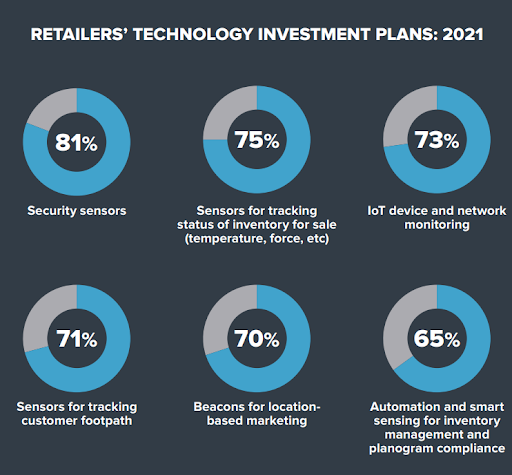
Source: Zebra
2. Automated delivery scheduling
Getting a driver and a customer to be in the same place at the same time is difficult. Automated scheduling software bridges this communication gap. When an order is placed, the system sends the customer a note to pick a time slot. These slots are based on AI-generated routes, often only minutes long. This prevents the "nightmare" of waiting at home all day for a parcel.
Scheduling like this helps deliver the flexibility that ranks so highly with consumers, who want to receive the package on their terms.
What modern retail customers demand from last-mile services
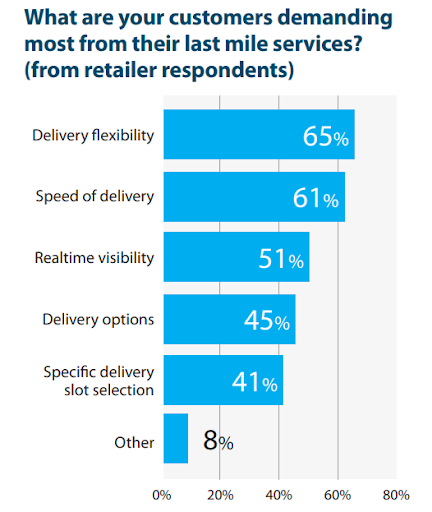
Source: Eye for Transport (EFT)
As we all know, customers who get what they want when they want it are much more likely to leave positive feedback.
3. Smart routes
Once time slots are set, algorithms generate the smart route. This optimization minimizes wrong turns and unnecessary trips. It uses live GPS data to avoid traffic jams in real-time.
Smart addressing also helps. If a customer enters an incomplete address, algorithms predict the location. This dramatically improves the chances of a successful first-time delivery.
Most systems even have an inbuilt metric that measures performance and provides automatic upgrades to saved data so that it’s continually self-improving.
4. Delivery paperwork
Traditional systems rely on reams of paperwork that waste time and space. Now, the moment a customer confirms they received an order, a digital data capture system uploads the delivery note and invoice. No more lost files or document backlogs—just efficiency.
5. Order tracking
Why was Uber so successful? Its GPS tracking kept customers informed. The same is true for courier services. According to OptimoRoute, almost 90% of customers reported a better experience when they had access to tracking.
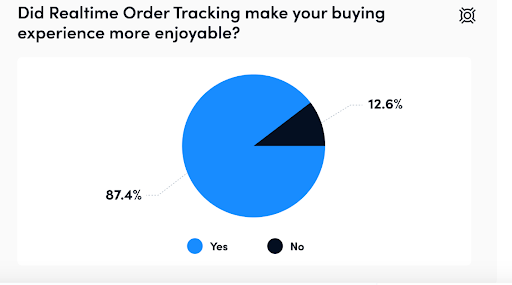
Source: OptimoRoute
An SMS confirms the ETA, and the customer can watch the courier’s location on a map. They can even message the driver if a problem arises. Together with smart routes, this "holy trinity" of technology helps retailers meet their SLAs.
Conclusion: Take the Lead in 2025
Logistics in the retail industry looks very different than it did just a few years ago. By embracing these five automated steps, your business can reduce costs and keep customers coming back.
Ready to incorporate these automation tools into your retail logistics operations? Sign up to swftbox in just five minutes to slash shipping costs, meet tight SLAs, and boost customer satisfaction.